
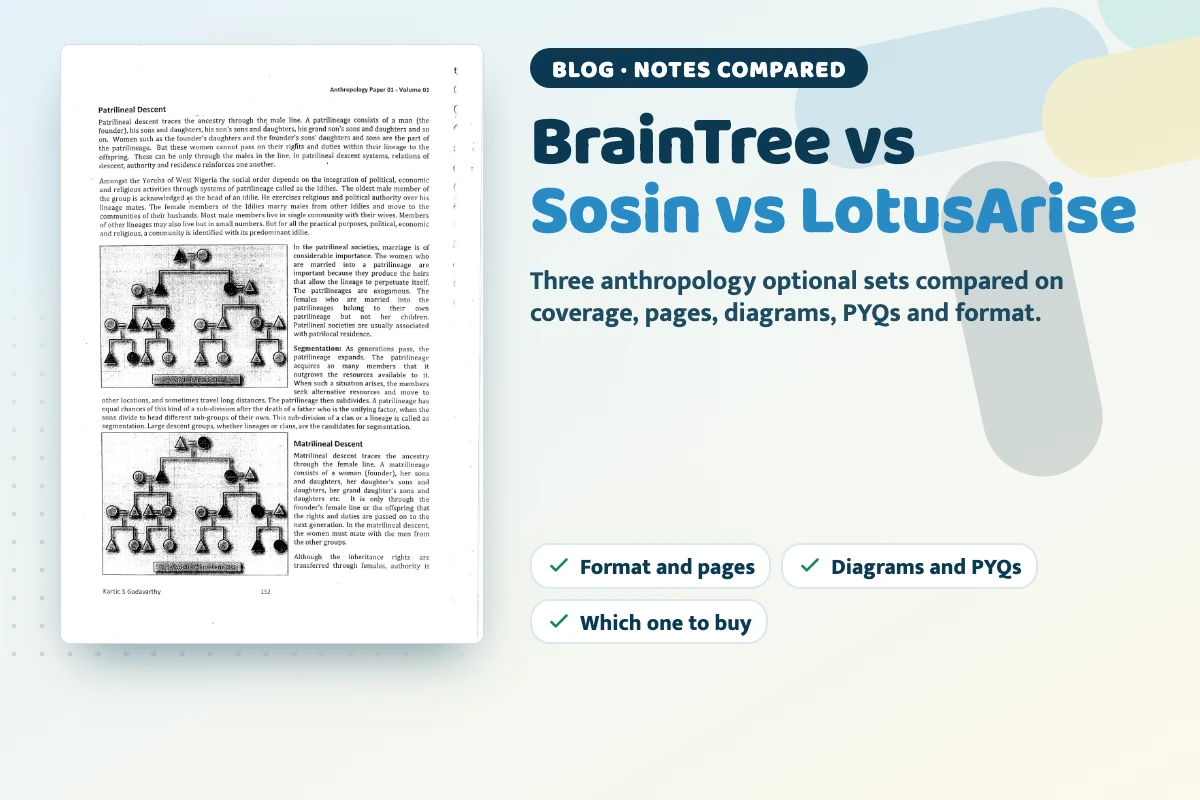
Ask any anthropology optional aspirant which notes to buy and three names come up again and again: BrainTree, Sosin Mam and LotusArise IAS. Two are classic coaching sets that circulate as printed booklets; the third is a newer, exam-first set written as one complete course.
This post compares all three on the things that decide your marks: syllabus coverage, depth on physical anthropology, Paper II examples, diagrams, built-in PYQs and format. Our pick is at the top; the details follow.
The verdict in one line each
- 1. LotusArise IAS (best overall): the most complete and up-to-date set, with 458 diagrams and PYQs in every chapter. See the LotusArise notes
- 2. BrainTree (best classic printed set): thorough, syllabus-wise coverage in three volumes plus a theories book, but no edition year and no built-in PYQs. Buy the BrainTree printed set
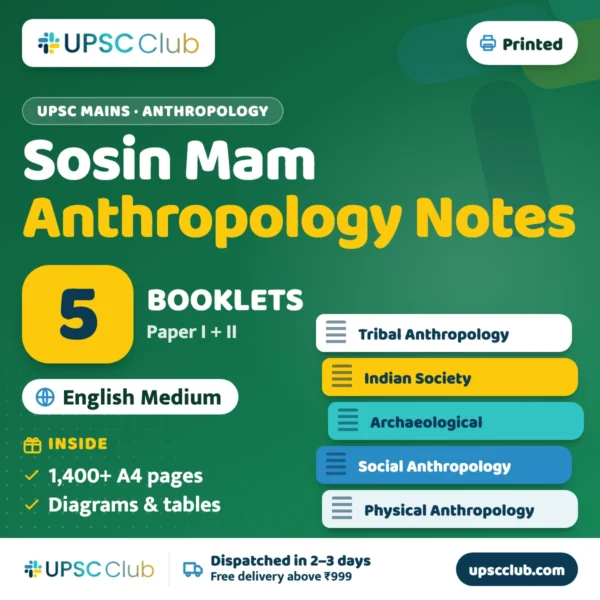
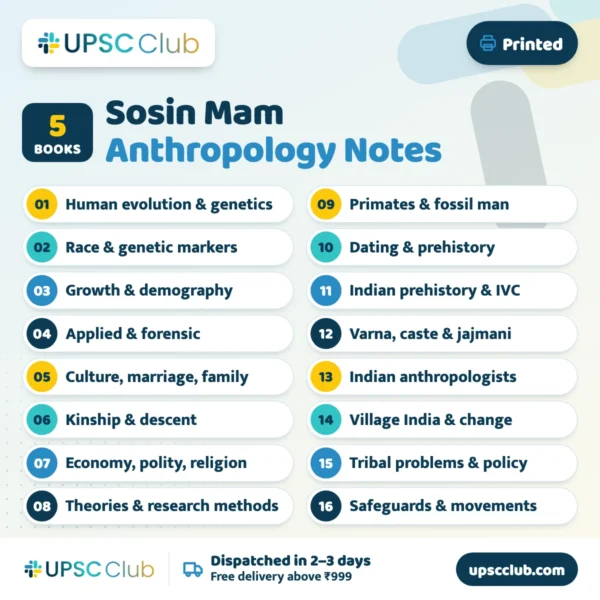
- 3. Sosin Mam (best for students of her classes): 5 books by Mrs. Sosin Thayyaba Revella, with a full book on tribal India. Buy the Sosin Mam printed set
Side-by-side comparison
| LotusArise IAS | BrainTree | Sosin Mam | |
|---|---|---|---|
| Author | LotusArise IAS | G.S. Karthik (BrainTree) | Mrs. Sosin Thayyaba Revella (Sosin Classes) |
| Books | 4 volumes + free PYQ book | 3 volumes + theories book | 5 books |
| Pages | 2,159 | About 1,000 A4 | Just over 1,400 A4 |
| Papers | Paper I and II | Paper I and II | Paper I and II |
| Order | Syllabus order, 87 chapters | Syllabus numbering (1.1 … 9.8) | Syllabus chapters, index in every book |
| Diagrams | 458 | Yes, photocopied | Yes, with the topics |
| Previous year questions | In every chapter + 1,855 topic-wise (1981–2026) | Not built in | Not built in |
| Edition year | PYQs up to 2026 included | Not printed | Not printed |
| Format | Printable A4 PDF, emailed on payment | Printed books, courier | Printed booklets, courier |
| Where to buy | LotusArise Store | UPSC Club | UPSC Club |
1. LotusArise IAS Anthropology Notes – best overall
LotusArise wrote its anthropology notes as a single course rather than a transcript of classroom lectures, and it shows in the structure. Every chapter starts with a topic map showing how often UPSC asks it, and ends with a revision grid and the previous year questions on that topic.
- 4 volumes, 2,159 pages, 87 chapters: Paper I Part A socio-cultural (722 pages), Paper I Part B physical and archaeological (646 pages), Paper II Part A Indian civilisation and society (432 pages), Paper II Part B tribal India (359 pages)
- 458 diagrams across both papers, from kinship charts and fossil skulls to growth curves and the Cernea model
- Previous year questions at the end of every chapter, plus a free PYQ book with 1,855 questions arranged topic-wise from 1981 to 2026 and all 26 full papers from 2014 to 2026
- A topic map on every chapter opener and a revision grid at the end of every chapter
- Printable A4 PDFs; the download links are emailed as soon as the payment clears
Where it beats the other two most clearly is Paper II and PYQs. Because the PYQ book runs to 2026 and every chapter carries its questions, you see exactly how a unit is asked before you write a single answer. The 458 diagrams are clean and drawn to be reproduced in the exam, unlike photocopied charts.
The trade-off is volume: at 2,159 pages it is roughly twice the size of BrainTree, and it comes as printable PDFs rather than bound books. For a deeper look, read our LotusArise anthropology notes review.
2. BrainTree Anthropology Notes – best classic printed set
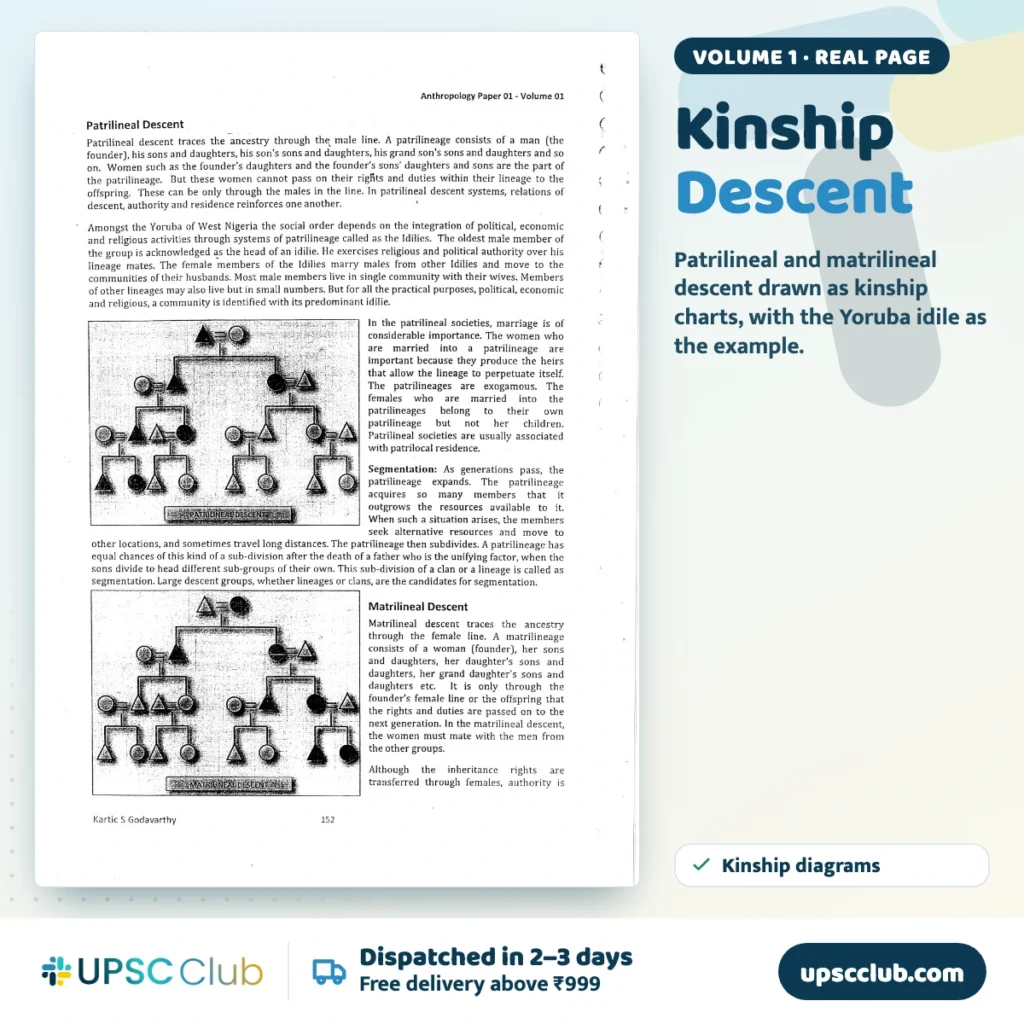
The BrainTree notes by G.S. Karthik are a set many anthropology aspirants have used for years. Volume 1 covers socio-cultural anthropology (339 pages), Volume 2 physical anthropology (285 pages), Volume 3 the whole of Paper II (368 pages), and a separate 90-page book covers anthropological theories thinker by thinker. We explain every volume, with real contents pages, in BrainTree anthropology Volume 1, 2, 3 and 4: what each book covers.
Strengths: every syllabus line is covered, the volumes follow the official numbering so you can tick units off, and the theories book is one of the best single treatments of unit 6.
Weaknesses: no edition year is printed, the pages are photocopies with some grainy diagrams, and there are no PYQs built in. Paper II needs recent examples added. Our BrainTree relevance review goes into this in detail.
3. Sosin Mam Anthropology Notes – best for students of her classes
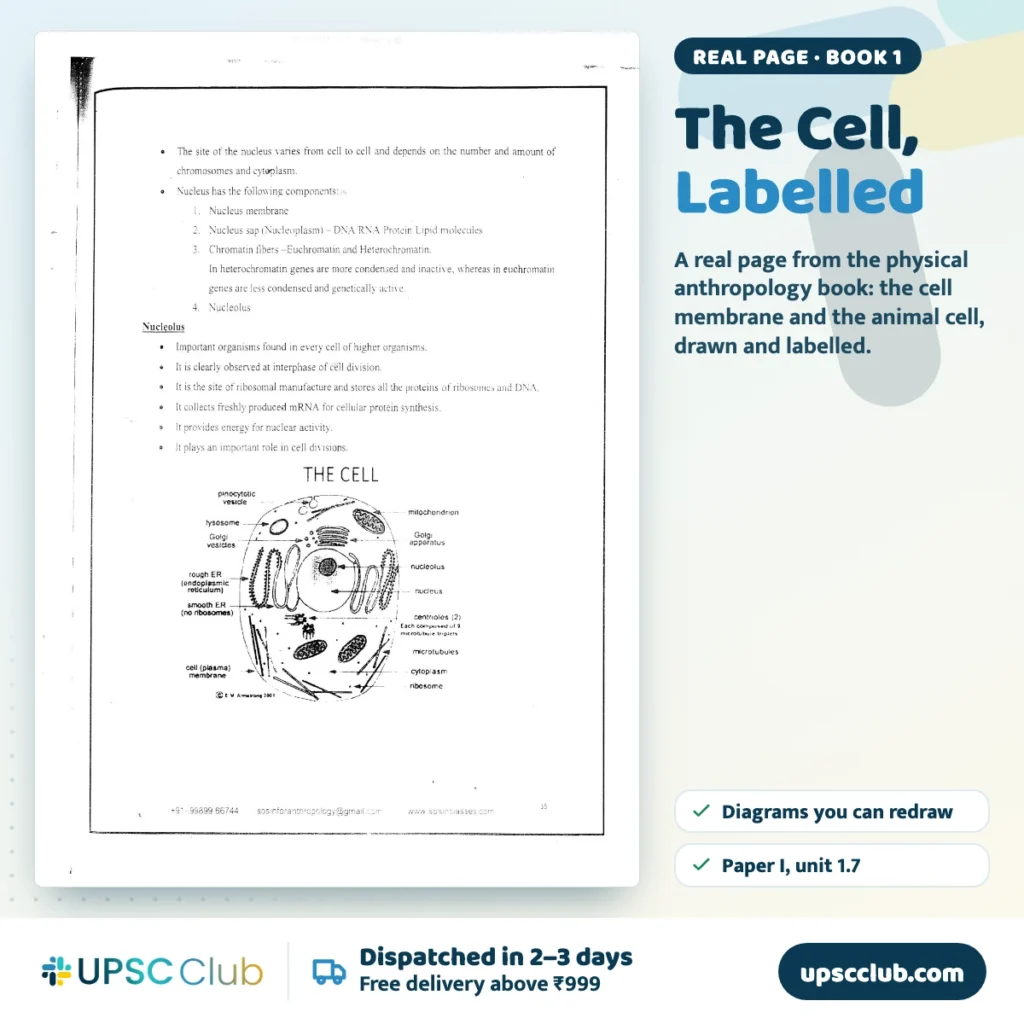
The Sosin notes are five books by Mrs. Sosin Thayyaba Revella of Sosin Classes, Hyderabad: Physical Anthropology (330 pages), Social Anthropology (225), Archaeological Anthropology and Indian Archaeology (222), Indian Society (297) and Tribal Anthropology (372). We explain every book, with real index pages, in Sosin Mam anthropology books: what each of the 5 booklets covers.
Strengths: clear indexes tied to the syllabus chapters, labelled diagrams and tables, separate sections on Indian anthropologists, and a full 372-page book on tribal India; a natural fit if you attend or follow her classes.
Weaknesses: the foreword says the booklets are meant to be used with class discussion and class notes, none of the indexes includes PYQs, and no edition year is printed. Read our honest Sosin review or the LotusArise vs Sosin comparison.
Which one should you buy?
| If you are… | Buy |
|---|---|
| Starting anthropology now and want one complete source | LotusArise Complete Notes |
| From a non-science background and worried about genetics | LotusArise Complete Notes (beginner summaries and clean diagrams) |
| Sure you want bound printed books | BrainTree printed set, then add PYQs |
| Attending or following Sosin Ma’am’s classes | Sosin Mam printed set |
| Already holding BrainTree or Sosin | LotusArise Paper 2 for case studies and PYQs |
Whichever base you choose, do not skip previous year questions and Paper II case studies: see where to find topic-wise solved PYQs and the top Paper 2 case studies. If you want to compare more sets, our top 5 anthropology notes review adds LevelUp IAS and Vaid’s ICS.
Frequently asked questions
Is BrainTree better than Sosin Mam for anthropology?
BrainTree has about 1,000 pages in four books, including a separate theories book; Sosin has just over 1,400 pages in five books, including a full book on tribal India. BrainTree follows the syllabus numbering line by line; Sosin is designed to go with her classes. LotusArise, at 2,159 pages with PYQs in every chapter, is more complete than either.
Which notes are best for anthropology Paper 2?
LotusArise, because its two Paper II volumes (432 and 359 pages) carry recent examples and every chapter ends with the previous year questions on that topic.
Are these notes available printed?
BrainTree and Sosin Mam are sold as printed sets, couriered across India. LotusArise comes as printable A4 PDFs emailed after payment, which you can print at any local shop.
Can I use BrainTree and LotusArise together?
Yes. Many aspirants keep BrainTree for the classical socio-cultural chapters and the theories book, and use LotusArise for physical anthropology, Paper II and PYQ practice.
Where can I buy them?
LotusArise from the LotusArise Store, and the BrainTree and Sosin printed sets from UPSC Club. Our guide to buying anthropology notes online lists what to check before you pay.

Join Our WhatsApp Channel
Get instant updates – Free and Premium Study Materials.
Join Our Telegram Channel
Exclusive PDFs, MCQs, Current Affairs and Study Materials.