
“Choosing between printed running notes and a dedicated, self-contained master system determines whether you spend months trying to decipher classroom shorthand or spend that time writing high-scoring answers.”
UPSC CSE Anthropology Strategy Review
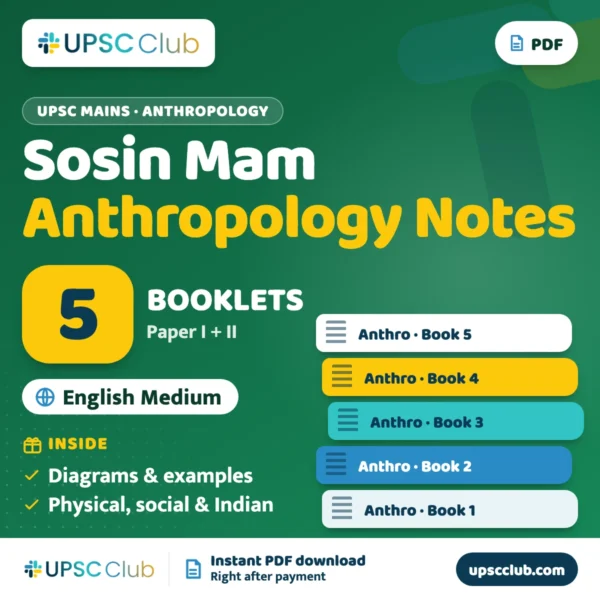
When selecting study material for the UPSC Anthropology optional, two of the most frequently compared resources across Telegram groups and Reddit discussion threads are LotusArise IAS Anthropology Master Notes and Sosin Mam (Target IAS) Classroom Notes.
Both resources enjoy strong popularity, but they cater to fundamentally different preparation styles. Sosin Mam’s notes reflect a teacher-guided, classroom lecture model, whereas LotusArise Notes provide a structured, self-contained, and comprehensive textbook-alternative system designed specifically for self-study and high-scoring answer reproduction.
In this detailed, objective review, we analyze both resources head-to-head across content depth, biological diagram readiness, Paper 2 contemporary grounding, and pre-Mains revision efficiency to help you choose the ideal material for UPSC 2026–2027.
Core Philosophy: Classroom Shorthand vs. Structured Master Notes
To make an informed decision, aspirants must understand how each set of notes was created:
- Sosin Mam Notes: These are compiled classroom lecture notes taken down by students during coaching sessions. They excel in socio-cultural concepts and theoretical links, but they inherit the natural flaws of running dictations: occasional handwriting ambiguities, fragmented sentences, and assumed context that is only explained verbally in class.
- LotusArise IAS Notes: These are custom-authored, digital master notes engineered from the ground up for the UPSC examination. Every single topic is broken down with a dual-layer approach: an opening “In Simple Words” callout box for absolute beginners, followed by structured headings, comparison tables, glossed technical terms, and print-ready diagrams.
Head-to-Head Comparison: LotusArise vs. Sosin Notes
The matrix below contrasts the critical dimensions that determine your score in UPSC Mains:
| Evaluation Feature | Sosin Mam (Target IAS) Notes | LotusArise IAS Master Notes |
|---|---|---|
| Creation & Format | Classroom running dictations / student transcripts | Authored master text (Answer-ready bullet points & tables) |
| Beginner Explanations | Requires watching lecture videos to understand context | Built-in “In Simple Words” boxes for first-time learners |
| Physical Anthropology & Genetics | Moderate; relies on standard P. Nath supplementation | Exhaustive synthesis of P. Nath & B.M. Das with clinical details |
| Diagrammatic Kit | Basic hand sketches from lecture blackboards | 4–6 high-yield print-ready diagrams in every single unit |
| Paper 2 Contemporary Case Studies | Standard sociological citations; older examples | Modern PVTGs, Forest Rights Act & Xaxa Committee reports |
| PYQ Integration | Unintegrated; requires separate question bank | Verbatim 35-year PYQs (1985–2025) embedded under each topic |
| Pre-Mains Revision | Cumbersome due to multi-volume running prose | High revision speed via Key Terms tables & Revision Grids |
1. Paper 1: Physical Anthropology, Genetics & Theories
Paper 1 is where the difference between both materials becomes decisive:
- In Physical Anthropology (Units 1.4–1.7 & Units 9–12): Sosin notes provide a helpful bird’s-eye view, but they lack the rigorous anatomical precision (cranial indices, dental formulas, carrying angle measurements, and biochemical enzyme markers) expected by UPSC evaluators. LotusArise Notes provide exact anatomical formulas and print-ready sketches (such as Gorilla vs. Human skull profiles, bipedal pelvic flaring, and chromosomal syndromes) that students can draw in under 90 seconds.
- In Anthropological Theories (Unit 6): Sosin notes are respected for explaining thinkers conversationally. However, LotusArise takes this a step further by structuring each theory into an unbreakable four-part template: Historical Context → Core Postulates → Ethnographic Field Studies → Critical Academic Legacy, making theoretical answers immediately scoring.
2. Paper 2: Tribal India and the “GS Trap”
Paper 2 is notorious for trapping candidates into writing generic, journalistic answers. To score 150+ marks, answers must be anchored in anthropological thinkers and verified field studies:
- Sosin Notes in Paper 2: Offer decent conceptual linkages between Indian social structure and tribal communities, but contemporary case studies are limited to older textbook cases from the 1990s.
- LotusArise Notes in Paper 2: Specifically designed to eliminate the GS trap. Every tribal unit embeds the 2014 Virginius Xaxa Committee findings, Forest Rights Act legal precedents, and contemporary case studies (such as the Dongria Kondh in Niyamgiri, Jenu Kurubas in Nagarhole, and Birhor PVTG sedentarization).
Final Verdict: Which One Should You Choose?
Your choice depends on your coaching enrollment and preparation timeline:
- Choose Sosin Notes ONLY IF: You are actively enrolled in Sosin Mam’s live classroom batches and can follow her spoken lectures alongside the written photocopies.
- Choose LotusArise IAS Master Notes IF: You are preparing through self-study, want a 100% self-contained resource that eliminates the need to buy 8 standard textbooks, and demand print-ready diagrams, contemporary case studies, and integrated 35-year PYQs.
To inspect curriculum modules and sample PDFs, visit the official LotusArise Anthropology Store or explore our comprehensive review of the Top 5 Best Notes for Anthropology Optional.


Join Our WhatsApp Channel
Get instant updates – Free and Premium Study Materials.
Join Our Telegram Channel
Exclusive PDFs, MCQs, Current Affairs and Study Materials.