
“Anthropology is often hailed as a safe, high-scoring optional, but scoring 300+ today is impossible with outdated coaching photocopies. Evaluators penalize generic answers and reward anatomical precision in Paper 1 and authentic anthropological framing in Paper 2.”
UPSC CSE Anthropology Evaluation Trends (2024–2026)
Selecting the best notes for Anthropology optional is one of the highest-leverage decisions in your UPSC Civil Services journey. With Anthropology consistently remaining one of the most chosen optional subjects among candidates, the benchmark for what constitutes an above-average answer has skyrocketed.
A few years ago, reading static coaching booklets or basic topper summaries was enough to cross 260 marks. However, the UPSC Mains examination pattern from 2023 to 2026 has witnessed a major paradigm shift. In Paper 1, evaluators expect exact biological nomenclature, precise evolutionary lineages, clear anatomical diagrams, and rigorous theoretical breakdowns. In Paper 2, questions on tribal policies and Indian social structure are designed to trap candidates into writing generic General Studies-style essays, resulting in poor marks unless anchored in core anthropological thinkers and specific field case studies.
In this comprehensive, unbiased guide, we evaluate and rank the top 5 Anthropology optional study materials available today—LotusArise IAS, BrainTree IAS, Sosin Mam (Target IAS), Karandeep Singh (LevelUp IAS), and Vaid’s ICS—to help you select the ideal foundation for your Mains preparation.
What Defines a High-Scoring Anthropology Note in 2026?
Before evaluating individual coaching materials, it is critical to assess any study resource against the four non-negotiable criteria required for a 300+ score in UPSC Mains:
- 100% Syllabus Coverage with Micro-Topic Mapping: Anthropology syllabus has 12 units in Paper 1 and 9 units in Paper 2. Notes must leave zero blind spots, covering peripheral yet frequently tested areas like linguistic anthropology, applied anthropology (forensics, ergonomics, defense), and specific tribal problems.
- Anatomical & Archaeological Diagram Ready: Physical anthropology and prehistoric archaeology cannot be cleared with text alone. Notes must provide clean, high-yield, reproducible diagrams (skull variations, craniometry, pelvic adaptations, tool cultures like Acheulian/Mousterian) that can be drawn in under 90 seconds.
- Paper 2 Anthropological Grounding (No GS Trap): The material must systematically integrate primary ethnographic fieldworks, committee reports (Xaxa Committee, Bhuria Committee, Virupaksha recommendations), and landmark thinkers (Verrier Elwin, G.S. Ghurye, L.P. Vidyarthi, B.K. Roy Burman) into every tribal and caste unit.
- Integrated 35-Year PYQs & Revision Feasibility: Notes must incorporate past UPSC questions directly within each topic and provide structured summaries for quick multi-cycle revision between Prelims and Mains.
At a Glance: Comparative Ranking of Best Notes for Anthropology Optional
The table below provides an objective side-by-side comparison across content depth, syllabus currency, diagram integration, and revision feasibility:
| Material / Institute | Content Depth & Currency | Paper 1 Diagrams | Paper 2 Case Studies | Self-Study Friendly? | Overall Verdict |
|---|---|---|---|---|---|
| 1. LotusArise IAS Notes | Comprehensive (2026–2027 edition); 100% syllabus; beginner layer | High-yield print diagrams included in every unit | Extensive (PVTGs, FRA, contemporary field studies) | Yes (10/10) — Self-contained with PYQs | Best Overall & Most Updated |
| 2. BrainTree IAS (Karna Sir) | Solid static foundation; somewhat dense; older compilation | Basic sketches; requires student drafting | Moderate; lacks recent tribal policy updates | Moderate (7/10) — Requires condensing | Great classical foundation, needs updating |
| 3. Sosin Mam (Target IAS) | Classroom-focused; good conceptual links in socio-cultural | Average; relies on running lecture notes | Good theoretical links; case studies need enrichment | Moderate (6.5/10) — Hard without lectures | Best suited alongside active coaching |
| 4. LevelUp IAS (Karandeep Singh) | Well-structured; strong theory & contemporary touch | Clean flowcharts & diagrams in handouts | Strong contemporary examples from test series | Good (8/10) — Detailed class handouts | Strong coaching handouts, bulky volume |
| 5. Vaid’s ICS (Vaid Sir) | Traditional stalwart; extensive legacy coverage | Standard textbook diagrams | Traditional sociological examples; dated policies | Moderate (6/10) — Inconsistent newer portions | Pioneering notes, but feels dated today |
1. LotusArise IAS Anthropology Notes — Rank #1 (The Gold Standard for 2026–2027)
LotusArise IAS stands firmly at the top of our ranking as the most meticulously updated, comprehensive, and student-centric study resource available for Anthropology optional today.
Unlike coaching class photocopies that rely on student scribbles or static material written a decade ago, LotusArise Anthropology Master Notes have been authored from the ground up specifically to align with the current UPSC Mains marking scheme. The entire syllabus is organized systematically into standalone, high-scoring modules covering both Paper 1 (Physical, Socio-Cultural, Archaeological, Linguistic) and Paper 2 (Indian Society, Tribal India, and Policy Dimensions).
Key Strengths of LotusArise Anthropology Notes:
- Dual-Layer Beginner-Friendly Design: Every major unit opens with an intuitive “In Simple Words” callout box, breaking down complex theories (like Claude Lévi-Strauss’s structuralism or synthetic evolutionary theory) into plain English before introducing scholars and debates.
- Flawless Physical Anthropology & Genetics: Units 1.4 to 1.7 and Units 9 to 12 are synthesized from authoritative academic texts (P. Nath, B.M. Das, Shukla & Rastogi) with clean genetic pedigree charts, somatometry calculations, and evolutionary trees that non-science students can master effortlessly.
- Rich Diagrammatic Kit: Every single article includes 4 to 6 print-ready anatomical and archaeological illustrations (cranial capacities, dental arcades, pelvic girdles, Olduvai Gorge stratigraphy, and stone tool evolutionary sequences).
- Paper 2 GS-Trap Immunity: Every tribal welfare issue is backed by anthropological thinkers (Elwin, Ghurye, Roy Burman, Vidyarthi), relevant constitutional protections, Forest Rights Act (FRA) ground realities, and specific PVTG field studies (Dongria Kondh, Birhor, Chenchu, Jenu Kuruba).
- Integrated 35-Year Topic-Wise PYQs: Past questions from 1985 to 2025 are mapped verbatim right beneath each relevant topic, allowing immediate answer-writing practice.
Best For: Both beginners starting from zero and veteran aspirants who want a single, authoritative, self-contained study material that eliminates the need to juggle 8 different textbooks or buy expensive coaching modules.
You can explore the full curriculum and sample chapters on the official LotusArise Anthropology Store or review foundational guides on the LotusArise Platform.
2. BrainTree IAS Notes (Karna Sir) — Rank #2 (The Classical Foundation)
For over a decade, BrainTree IAS notes (associated with Kartic Godavarthy / Karna Sir in Hyderabad) have served as the staple starting point for civil services aspirants across India. They are renowned for their academic rigor, particularly in socio-cultural anthropology and classical theories. You can buy the BrainTree anthropology notes online as a printed set of four books for Paper I & II.
Pros & Cons:
- Strengths: Highly structured explanation of core socio-cultural institutions (marriage, family, kinship, economic and political systems). Excellent breakdown of classical anthropological schools (Evolutionism, Historical Particularism, Functionalism).
- Limitations: The printed booklets are quite dense and written in a textbook format rather than an exam-ready answer layout. Paper 2 sections lack recent tribal developmental data, contemporary court judgments on forest rights, and modern genomic updates. Aspirants must invest substantial time condensing Braintree into their own revision notes.
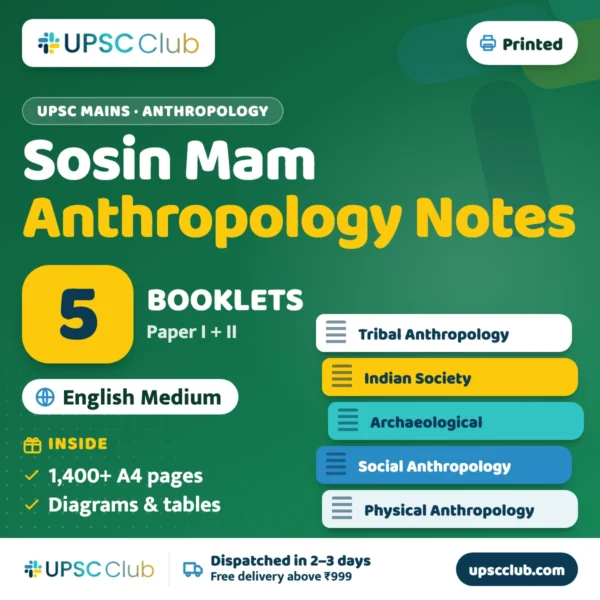
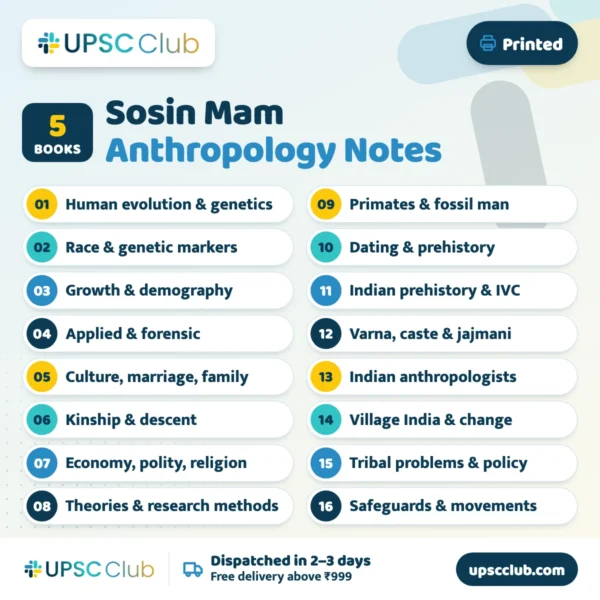
3. Sosin Mam (Target IAS) Notes — Rank #3 (The Classroom Favourite)
Sosin Mam has built a dedicated following on Telegram and YouTube. Her classroom lecture notes and printed compilations are widely circulated among aspirants who prefer a conversational, teacher-guided approach to anthropology.
Pros & Cons:
- Strengths: Simplifies theoretical jargon and builds cross-linkages between Paper 1 thinkers and Paper 2 Indian social structure. Good coverage of socio-cultural units and cultural change models.
- Limitations: As with most classroom running notes, the material often feels incomplete or disjointed unless supplemented by her live video lectures. Beginners reading the notes in isolation may find concepts mixed together, requiring standard textbooks (like Ember & Ember or P. Nath) to fill foundational gaps.
4. Karandeep Singh / LevelUp IAS Handouts — Rank #4 (The Modern Classroom Competitor)
Karandeep Singh at LevelUp IAS has emerged as one of the most popular contemporary classroom teachers for Anthropology in Old Rajinder Nagar (ORN). His lecture handouts reflect recent exam trends, with strong integration of model answers and test series discussions.
Pros & Cons:
- Strengths: Up-to-date analysis of recent PYQs; clean framework for structuring 15-mark and 20-mark answers; good value-addition case studies in tribal developmental schemes.
- Limitations: The handouts are voluminous and spread across dozens of lecture sheets and test-series booklets. For self-study aspirants who are not enrolled in his full foundation batches, consolidating the materials into a concise, unified revision note requires significant effort.
5. Vaid’s ICS (Vaid Sir) Notes — Rank #5 (The Veteran Pioneer)
Vaid’s ICS represents the pioneering generation of UPSC Anthropology guidance in Delhi. Many senior civil servants initially prepared using Vaid Sir’s material and classroom coaching.
Pros & Cons:
- Strengths: Traditional, textbook-style conceptual definitions. Strong foundational clarity for Paper 1 physical anthropology fundamentals.
- Limitations: Contemporary UPSC candidates on forums frequently point out that the material has not kept pace with the latest analytical question framing or modern sub-disciplines (such as molecular anthropology, ancient DNA findings, and recent policy reports). It serves well as a secondary reference but is rarely sufficient as a standalone source today.
Final Recommendation: Which Anthropology Notes Should You Choose?
Your choice of notes directly impacts your study efficiency and exam performance. Here is our direct strategic recommendation:
- If you want the most complete, updated, and ready-to-revise resource: Go with LotusArise IAS Notes. It provides 100% syllabus coverage, beginner explanations, print-ready diagrams, and 35-year PYQs in a clean, unified system that saves you 4 to 6 months of note-making.
- If you already have BrainTree or Sosin notes: You do not need to discard them completely, but you must aggressively supplement them with contemporary Paper 2 case studies, high-yield biological diagrams, and post-2020 PYQs to ensure your answers stand out from generic coaching photocopies.
For more detailed subject guidance, check out the official syllabus on the UPSC Civil Services Examination portal and explore our dedicated UPSC Optional strategy section.
Join Our WhatsApp Channel
Get instant updates – Free and Premium Study Materials.
Join Our Telegram Channel
Exclusive PDFs, MCQs, Current Affairs and Study Materials.