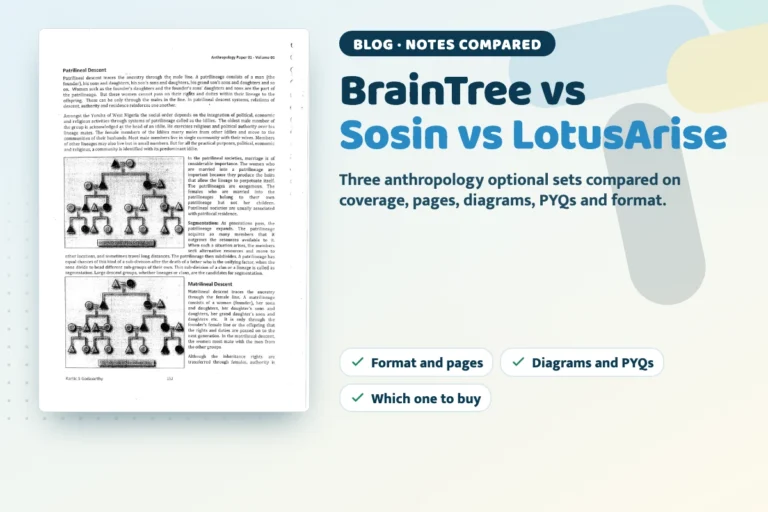
“BrainTree notes were the undisputed bible for Anthropology a decade ago. But UPSC Mains has evolved dramatically into an applied, analytical exam. Relying exclusively on static, unedited photocopies from 2014 is one of the quickest ways to get stuck at 230–250 marks.”
UPSC CSE Anthropology Faculty & Topper Debrief
If you have spent any time browsing UPSC preparation forums on Reddit, Quora, or Telegram, you have inevitably encountered BrainTree Anthropology notes (authored by Kartic Godavarthy / Karna Sir). For years, these spiral-bound booklets have been passed down from senior aspirants to beginners as the ultimate foundational material for the subject. If you want the original set, you can buy the BrainTree anthropology printed notes online (three volumes plus the theories book, Paper I & II).
However, as the competition intensifies and UPSC increasingly designs questions that test contemporary field dynamics, molecular genetics, and complex tribal realities, thousands of aspirants are asking a critical question: Are BrainTree Anthropology notes still relevant for UPSC CSE, or have they become outdated?
In this candid, analytical review, we dissect the real strengths and critical gaps of BrainTree material, evaluate how it fares against modern UPSC evaluation criteria, and explain why LotusArise IAS Anthropology Notes have emerged as the modern, high-scoring alternative for 2026–2027 aspirants.
Why BrainTree Notes Became the Industry Benchmark
To understand the current dilemma, one must acknowledge why BrainTree notes earned their legendary reputation in the first place:
- Rigorous Academic Foundations: Karna Sir synthesized dense classical texts (Ember & Ember, Majumdar & Madan, Upadhyay & Pandey) into structured thematic booklets covering marriage, kinship, religion, and classical anthropological theories.
- Comprehensive Scope: Unlike short coaching handouts that skip peripheral topics, BrainTree ensured that every line of the static syllabus was addressed in writing.
- Conceptual Clarity: The breakdown of complex theoretical debates—such as the Malinowski vs. Radcliffe-Brown structural-functionalist schism—was lucid and easy to grasp for non-anthropology graduates.
Despite these strengths, the exam for which BrainTree was originally designed no longer exists in the same format.
The 4 Major Limitations of BrainTree Notes in Today’s UPSC Pattern
Aspirants attempting recent UPSC Mains examinations face four major bottlenecks when relying solely on BrainTree notes:
1. Outdated Paper 2 Content & Missing Tribal Policy Dynamics
Paper 2 is where the age of BrainTree material becomes most apparent. Modern UPSC questions on Tribal India do not simply ask for descriptive essays on the “Problems of Tribal Youth.” They demand analytical assessments of the Forest Rights Act (FRA 2006) implementation bottlenecks, eco-tourism conflicts, Particularly Vulnerable Tribal Groups (PVTGs) rehabilitation failures, the High-Level Committee (Xaxa Committee) recommendations, and contemporary tribal movements.
BrainTree’s Paper 2 booklets are predominantly anchored in older ethnographic descriptions from the 1980s and 1990s, forcing aspirants to seek extensive value addition elsewhere to avoid scoring below average in Paper 2.
2. High Volume, Zero Answer-Readiness (The Cognitive Overload)
BrainTree notes read like an academic textbook rather than an answer-writing manual. Paragraphs are long, dense, and unformatted. There are no bulleted arguments, ready-made introductions, scholar quote callouts, or concluding synthesis statements. To make BrainTree exam-ready, an aspirant must spend 4 to 6 months summarizing the material into personal short notes—time that could be far better spent on answer writing and revision.
3. Lack of Print-Ready Anatomical Diagrams in Paper 1
Physical anthropology (Units 1.4 to 1.7 and Units 9 to 12) is the ultimate scoring engine of Anthropology optional. In these units, evaluators expect crisp, anatomical sketches: cranial differences between Neanderthal and Cro-Magnon, pelvis adaptations for bipedalism, dentition patterns, and chromosomal banding diagrams.
BrainTree material contains rudimentary hand sketches or no diagrams at all for critical sections, forcing candidates to separately scramble through P. Nath, B.M. Das, or medical textbooks.
4. Disconnect from Modern Applied PYQ Trends
Over the last 5 years, UPSC has introduced interdisciplinary questions linking genetics with epidemiology, forensics, ergonomics in defense design, and linguistic relativity. Because BrainTree compilation was fixed years ago, it lacks integrated topic-wise PYQs from 2018 to 2025, leaving candidates unprepared for modern question phrasing.
Direct Comparison: BrainTree Notes vs. LotusArise IAS Anthropology Notes
The table below provides a detailed structural comparison between the legacy BrainTree notes and the modern LotusArise IAS Master Notes:
| Evaluation Parameter | BrainTree IAS Notes | LotusArise IAS Master Notes |
|---|---|---|
| Edition & Currency | Older compilation (infrequent static updates) | 2026–2027 Edition (Systematically updated for latest trends) |
| Format & Layout | Dense academic paragraphs; requires personal condensing | Structured answer architecture (Bullets, tables, bold key points) |
| Beginner Layer | Textbook tone; jargon-heavy at start | “In Simple Words” callouts & terms glossed at first mention |
| Physical Anthro Diagrams | Minimal or crude sketches | 4–6 high-yield print-ready diagrams per unit (skulls, anatomy, genetics) |
| Paper 2 Case Studies | Generic / older ethnographic records | Real-world case studies (Niyamgiri, Nagarhole, PVTGs, FRA, Xaxa Committee) |
| PYQ Integration | Separate booklets or unintegrated lists | 35-Year Topic-Wise PYQs (1985–2025) mapped under each topic |
| Pre-Mains Revision | Extremely bulky (1,800+ pages of dense prose) | High revision efficiency with Key Terms tables & Revision Grids |
Why LotusArise IAS Notes Are the Natural Modern Successor
LotusArise IAS has solved the exact pain points that modern aspirants experience with older materials like BrainTree. Designed with the perspective of a first-time reader who aims for a 300+ score, LotusArise Master Notes incorporate several breakthrough features:
- The “Simple Words” Layer: Eliminates initial frustration by giving a 2–3 sentence plain summary at the beginning of every major topic, explaining what the concept is and why it matters before diving into dense scholarly discourse.
- Full Syllabus Parity: Zero selective omissions. Every single micro-topic from Unit 1.1 to 12 in Paper 1 and Unit 1 to 9 in Paper 2 is fully covered.
- Instant Answer-Ready Framing: Content is pre-organized into introductory definitions, core theoretical pillars, comparative matrix tables, scholar viewpoints, and grounded conclusions.
- Integrated Revision Toolkit: Each article concludes with a dedicated “Key Terms” table and a “Diagrams to Master” checklist, making 48-hour pre-exam revision seamless.
Aspirants looking to upgrade their study material can explore the complete curriculum on the LotusArise Anthropology Notes Store or access comprehensive strategy articles on the LotusArise main platform.
Verdict: What Should You Do if You Already Own BrainTree Notes?
If you have already invested in BrainTree booklets, here is the pragmatic path forward:
- Retain for Core Socio-Cultural Concepts: You can safely use BrainTree’s Paper 1 Units 2 to 5 for classical understanding of marriage, family, kinship, and religion.
- Do NOT Rely on BrainTree for Paper 2: You must completely overhaul your Paper 2 notes using contemporary sources, official reports (Xaxa Committee, Ministry of Tribal Affairs publications), and modern case studies.
- Integrate a Modern Diagram & PYQ Solution: Pair your readings with a modern, structured resource like LotusArise IAS Notes to acquire print-ready anatomical diagrams, 35-year solved PYQs, and structured revision grids that bridge the gap between static theory and a 300+ score.
For more comparisons and optional strategies, explore our guide on the Top Best Notes for Anthropology Optional UPSC, see what is inside each volume of the BrainTree anthropology printed notes, and stay updated with official notifications on the UPSC Official Portal.


Join Our WhatsApp Channel
Get instant updates – Free and Premium Study Materials.
Join Our Telegram Channel
Exclusive PDFs, MCQs, Current Affairs and Study Materials.