
“The choice between Anthropology and Sociology comes down to a fundamental trade-off: do you want an objective, scientific syllabus where correct diagrams yield mathematical marks, or an interpretive, essay-heavy subject with broad overlap across General Studies?”
UPSC CSE Optional Strategy Insights
When selecting a non-technical optional subject for the UPSC Civil Services Examination, the most frequent dilemma aspirants face is deciding between Anthropology and Sociology. Both subjects are immensely popular, boast impressive success ratios, and require no mandatory prior academic background.
However, beneath their surface similarities, the two subjects demand radically different cognitive mindsets and answer-writing styles. Aspirants on discussion forums like Reddit r/UPSC and ForumIAS frequently debate which subject is genuinely easier to complete and which offers a more reliable path to the coveted 300+ mark benchmark.
In this comprehensive, honest analysis, we evaluate both optionals across syllabus size, scoring predictability, General Studies overlap, and preparation timelines to help you make the right choice for UPSC 2026–2027.
Syllabus Structure & Cognitive Demands Compared
Understanding how the two syllabi are organized reveals the kind of preparation each subject demands:
- Anthropology: The syllabus is exceptionally well-defined and split into distinct biological and social branches. Paper 1 contains Physical Anthropology (Human Evolution, Primates, Genetics, Forensic Anthropology), Prehistoric Archaeology, and Socio-Cultural Theories. Paper 2 focuses on Indian Society, Caste, and Tribal Development. Over 50% of the syllabus is concrete, static science where facts do not change.
- Sociology: The syllabus looks deceptively concise on paper (10 units in Paper 1 and 3 broad sections in Paper 2). However, Sociology is entirely interpretive. Paper 1 requires mastering classical thinkers (Marx, Weber, Durkheim, Parsons, Mead, Merton) and their competing paradigms. Paper 2 analyzes Indian social structure, social movements, and modernization, demanding extensive reading between the lines and constant articulation of sociological perspectives.
Direct Comparison: Anthropology vs. Sociology Optional
The comparative matrix below highlights how both optionals perform across crucial examination parameters:
| Preparation Dimension | Anthropology Optional | Sociology Optional |
|---|---|---|
| Syllabus Definiteness | Very High (Concrete boundaries; minimal ambiguity) | Moderate (Broad, interpretive concepts) |
| Nature of Content | 50% Science (Genetics, Biology) + 50% Social | 100% Social Science & Theoretical Paradigms |
| Scoring Predictability | Very High (Mathematical marking in Physical Anthro) | Moderate (Subjective; evaluator-dependent) |
| Diagrammatic Potential | Extensive (Anatomical skulls, pelvis, tools, pedigree) | Minimal (Primarily conceptual flowcharts) |
| General Studies Overlap | Moderate (GS 1 Society, Tribals, minor GS 3) | Extensive (GS 1 Society, GS 2 Social Justice, Essay) |
| Time to Complete | 3.5 to 4 Months (With structured notes) | 4.5 to 5.5 Months (Extensive thinker reading) |
| Revision Speed in 5-Day Gap | Fast (Objective terms & visual diagrams) | Moderate (Dense argumentative prose) |
Scoring Predictability: The Decisive Factor
The primary reason top rankers consistently recommend Anthropology over Sociology is scoring predictability:
In Anthropology Paper 1, questions on Neanderthal cranial features, the Hardy-Weinberg equilibrium, ABO blood polymorphism, or Acheulian tool traditions have objectively correct answers. If you provide accurate scientific terminology, label your diagrams neatly, and state the exact genetic formulas, evaluators award 7.5 or 8 out of 10 marks without hesitation. This creates a realistic ceiling of 160 to 170 marks in Paper 1.
In contrast, Sociology is inherently interpretive. When answering questions on Weber’s Protestant Ethic, Parsons’ AGIL framework, or caste dynamics in modern India, there is no single right answer. Evaluator bias plays a noticeable role: a functionalist examiner might grade differently from a Marxist scholar. Consequently, while many candidates score a solid 250 to 270 in Sociology, pushing past 290 requires exceptional literary flair and theoretical subtlety.
General Studies Overlap: Where Sociology Gains an Edge
Sociology’s major strength is its synergy with the General Studies syllabus:
- GS Paper 1: Covers approximately 50 to 60 marks of Indian Society (secularism, communalism, regionalism, women’s movements, globalization).
- GS Paper 2: Directly aids in Social Justice, poverty, hunger, and civil society mechanisms.
- Essay Paper: Provides philosophical and societal frameworks that elevate philosophical essays.
Anthropology also overlaps with GS 1 (tribal issues, Indian diversity, prehistoric culture) and parts of GS 3 (biotechnology and human genetics), but its overall GS footprint is smaller. However, most successful candidates argue that the 30 to 40 additional marks you can gain in Anthropology easily compensate for the slightly higher GS overlap of Sociology.
Final Decision Matrix: Which Should You Pick?
Choose Anthropology if:
- You want an objective, predictable optional with clear boundaries and minimal ambiguity.
- You are comfortable memorizing anatomical diagrams, biological terms, and prehistoric tool sequences.
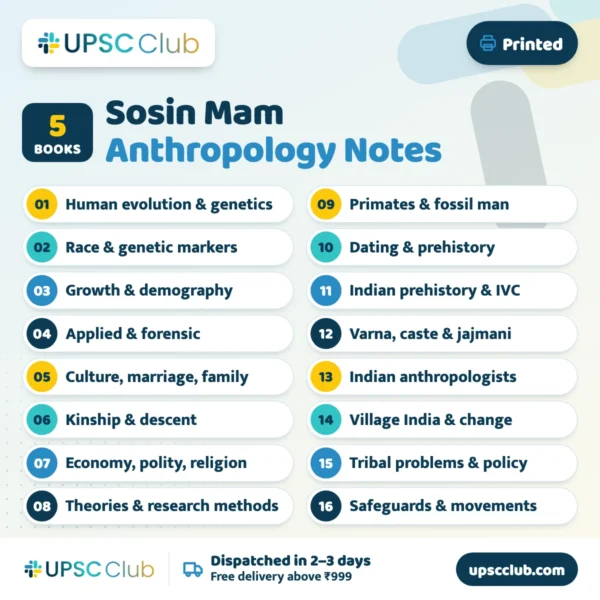
- You want to finish your core syllabus in 3.5 to 4 months using structured, all-in-one resources like LotusArise IAS Anthropology Master Notes.
Choose Sociology if:
- You have an absolute aversion to biological science and refuse to draw anatomical diagrams.
- You enjoy reading social philosophy, writing discursive essays, and analyzing society through theoretical lenses.
- Your primary focus is maximizing GS 1 and Essay overlap.
For detailed Anthropology study resources, explore the official LotusArise Anthropology Store or check out our guide on Best Notes for Anthropology Optional UPSC.

Join Our WhatsApp Channel
Get instant updates – Free and Premium Study Materials.
Join Our Telegram Channel
Exclusive PDFs, MCQs, Current Affairs and Study Materials.