
In the UPSC Political Science and International Relations (PSIR) optional, previous year questions (PYQs) are not merely a tool for post-syllabus self-assessment. They are the functional syllabus itself.
Over 65% to 70% of questions asked in any given UPSC PSIR Mains paper are direct repetitions, analytical twists, or thematic continuations of questions asked over the past three decades:
- In Paper 1A, John Locke’s theory of property, Gramsci’s hegemony, and Rawls’ difference principle reappear in cyclical patterns.
- In Paper 1B, the debate on asymmetric federalism, the politicization of caste, and judicial activism vs. restraint recur consistently.
- In Paper 2A & 2B, the relevance of the Non-Aligned Movement, structural realism vs. liberal institutionalism, and India’s strategic autonomy are tested in every examination cycle.
However, many aspirants waste valuable time using poorly organized, chronological, or outdated market compilations with low-quality model answers.
In this guide, we review the top PSIR PYQ compilations available today, evaluate their strengths and limitations, and break down the exact methodology to use them for a 300+ score.
What Makes an Effective PSIR PYQ Compilation?
Before buying any question bank, evaluate it against these four non-negotiable criteria:
- Granular Topic-Wise Segregation (Not Just Year-Wise): Year-wise papers (e.g., the 2021 full paper) are useful only in the final month for 3-hour exam simulations. During your primary preparation, you need topic-wise segregation so that when you finish studying Thomas Hobbes, you can immediately solve every Hobbes question asked since 1991.
- Comprehensive Time Span (25+ Years): Looking at only the last 5 years is dangerous. UPSC regularly revives conceptual questions asked in 1995, 2002, or 2011 with fresh contemporary phrasing. A compilation spanning 1991 to 2026 gives you complete pattern visibility.
- Marks and Trend Weightage: Does the book tell you the exact mark distribution across the last 10 years, showing you which units are high-yield and which can be covered lightly?
- Answer Quality (Optional Standard vs. Generic GS): If model answers are included, do they follow the Theory–Dialectic–Synthesis framework with specific scholar citations, or do they read like generic essays written by non-specialists?
Head-to-Head Comparison of Top PSIR PYQ Compilations
| Feature / Resource | LotusArise PSIR PYQ Compilation (1991–2026) | Shubhra Ranjan Quest / 500+ PYQs | Vivek Waghmare PYQ Decoded (2013–2024) | Standard Market Books (New Vishal / Arihant) |
|---|---|---|---|---|
| Time Span | 35+ Years (1991–2026) | Typically last 8–10 years | 12 Years (2013–2024) | 10–15 Years (Varies) |
| Categorization | Granular Syllabus Micro-Units (40 Units) | Broad topic-wise headings | Segregated topic-wise themes | Broad chapters or chronological years |
| Marks & Weightage Charts | Yes: 10-year trend and unit-weightage breakdown | No systematic weightage charts | Highlights important recurring themes | Raw marks listed per question |
| Model Solutions Standard | High academic rigour; integrated into Revision Booklets | Dictated classroom answers (available via course) | Focuses on question categorization | Generic, low-depth answers (GS style) |
| Contemporary IR Currency | Fully updated with post-2023–2026 realignments | Varies with recent batch handouts | Covers 2013–2024 trends | Frequently outdated on contemporary IR |
| Ease of Revision | High: Paired with modular exam cards | Moderate (Scattered notes) | Good (Compact 76 pages) | Bulky paperback format |
1. LotusArise PSIR PYQ Compilation (1991–2026): The Gold Standard
Overview
LotusArise provides one of the most comprehensive and structurally rigorous PYQ resources in the UPSC ecosystem: a 194-page master compilation covering over 1,470 questions from 1991 through 2026, organized across all 40 syllabus units.
Why It Stands Out:
- True 35-Year Exhaustive Horizon: While most coaching compilations stop at 2013, LotusArise includes foundational questions dating back to 1991. This reveals how UPSC recycles older theoretical questions (e.g., early debates on Gramsci’s historic bloc or Kautilya’s diplomacy) and applies them to modern scenarios.
- 10-Year Unit Weightage Analytics: At the start of every section, it features analytical data charts illustrating where UPSC’s marks have concentrated over the last decade. For example, it highlights that Western Political Thought, Ideologies, and Indian Political Thought account for nearly 45% of Paper 1A marks, allowing you to allocate your study hours with mathematical precision.
- The Two-Tier Solution Ecosystem: Rather than offering bulky, paragraph-heavy model answers that are impossible to memorize, LotusArise pairs its PYQ compilation with its 5 Revision Booklets (~643 pages). Each syllabus unit card provides:
- Thinkers to Name Table (exact scholars and texts to answer that theme’s PYQs)
- Common Exam Traps (identifying common mistakes candidates make on that specific question)
- Ready Answer Frames (pre-tested intro and conclusion frameworks tailored for 10- and 15-mark questions)
Best For: Aspirants who want complete question visibility from 1991 to 2026 alongside actionable, ready-to-write answer frameworks.
2. Shubhra Ranjan Quest / 500+ PYQ Compilations
Overview
Shubhra Ranjan IAS compiles past year questions under her “Quest / 500+ Answer Writing” initiatives, organizing questions around primary themes taught in her classroom.
Strengths:
- Direct Classroom Alignment: If you are already attending her classes, her PYQ categorization follows her exact lecture sequence, making it natural to review class notes alongside past questions.
- Familiar Model Answers: Model answers provided in her test series and classroom crash courses utilize her familiar catchphrases (“child of his times”, “intellectual midwife”).
Limitations:
- Access Restrictions: These compilations are typically bundled with expensive classroom programs or crash courses, or circulate as poorly photocopied Xerox booklets in the Karol Bagh market.
- The “Template Fatigue” Risk: Thousands of aspirants use the exact same model answers, leading to identical scripts in the exam hall that often struggle to cross the 240–255 mark plateau.
Best For: Students enrolled in Shubhra Ranjan’s classroom program who want an aligned practice tracker.
3. Vivek Waghmare PSIR PYQ Decoded (2013–2024)
Overview
Compiled by educator Vivek Waghmare, this is a clean, modern 76-page digital PDF that segregates questions from 2013 through 2024 into distinct syllabus themes.
Strengths:
- Compact & Lightweight: At 76 pages, it is extremely easy to navigate on a tablet or laptop without feeling overwhelmed.
- Theme Highlighting: Clearly groups questions under micro-themes (e.g., under Political Theory: Normative vs. Empirical Approaches, Behavioral Revolution, Post-Behavioralism).
Limitations:
- Narrower Time Window: Spans 12 years (2013–2024), missing the older 1990s and 2000s conceptual questions that UPSC frequently draws inspiration from.
- No Direct Model Answers: Functions primarily as a categorized question list rather than a comprehensive solution manual.
Best For: Candidates seeking a quick, clean, theme-wise question checklist for the modern exam pattern (post-2013 syllabus revision).
4. Commercial Market Paperbacks (New Vishal, Arihant, Kiran)
Overview
Widely available at offline bookshops and online marketplaces, these are printed paperbacks compiling previous year papers.
Strengths:
- Inexpensive and Easily Accessible: Readily available in physical print format.
- Good for Full-Length Mock Simulation: Often include complete, year-wise question papers (e.g., Full Paper 2022, Full Paper 2023) useful for timed 3-hour writing drills.
Limitations:
- Poor Model Answer Quality: This is their biggest flaw. Model answers in commercial paperbacks are frequently outsourced to freelance content writers with no background in political science. Answers read like generic General Studies points, lack scholar citations, and miss theoretical frameworks.
- Outdated Paper 2 Content: Model answers for International Relations often cite obsolete trade data and superseded diplomatic policies.
Best For: Candidates who want cheap physical paperbacks purely to look at raw, unannotated past question papers.
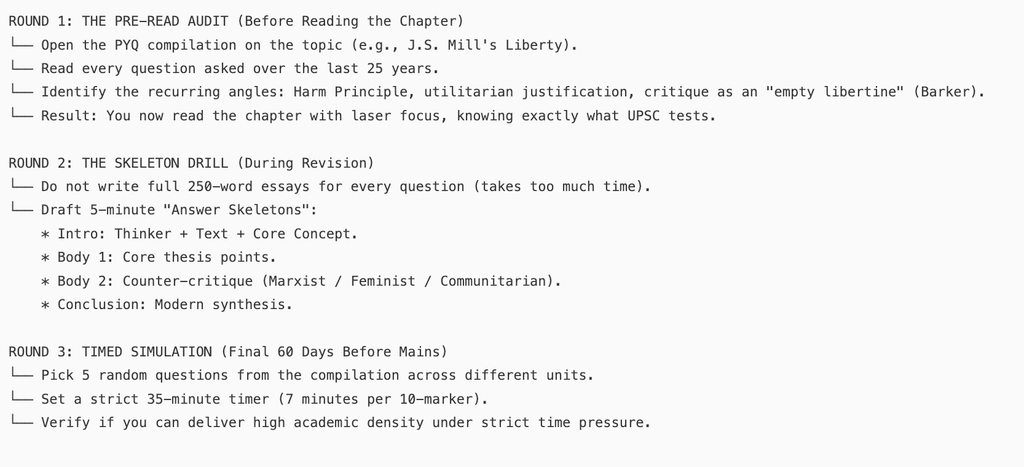
The 3-Round Strategy: How to Actually Use PYQs to Score 300+
Owning the best compilation is only half the battle. Here is the 3-round methodology used by toppers to convert PYQs into high scores:
The Final Recommendation
- For Complete Preparation (1991–2026): Choose the LotusArise PSIR PYQ Compilation. Its 35-year historical horizon, unit weightage analytics, and direct alignment with the LotusArise Revision Booklets make it the most comprehensive, high-scoring tool available.
- For Quick Micro-Listing: If you only need a clean, post-2013 thematic checklist to track your syllabus completion, Vivek Waghmare’s 76-page PDF is a great supplementary reference.
- Avoid Commercial Paperback Solutions: Do not waste money on generic commercial publishers (Arihant, Kiran) for model answers—their non-specialist answers will drag your writing down to General Studies standards.




Join Our WhatsApp Channel
Get instant updates – Free and Premium Study Materials.
Join Our Telegram Channel
Exclusive PDFs, MCQs, Current Affairs and Study Materials.