Search for the BrainTree anthropology notes and you quickly meet a confusing set of names: Volume 1, Volume 2, Volume 3, Part 4, Book 1. Sellers number the books differently, and most listings never say what is inside each one.
This guide fixes that. We went through a complete printed set of the BrainTree anthropology notes by G.S. Karthik page by page, and below you will find what each volume covers, how many pages it has, which syllabus units it maps to, and the real contents pages. At the end we explain where the set falls short for today’s Mains and what we recommend instead.
BrainTree anthropology volumes at a glance
| Book | Paper | Pages | Syllabus units |
|---|---|---|---|
| Volume 1 | Paper I | 339 | 1.1–1.3, 1.8, 2 to 8: scope, prehistoric archaeology, culture, marriage, family, kinship, economy, polity, religion, theories, language, research methods |
| Volume 2 | Paper I | 285 | 1.4–1.7, 9 to 12: evolution, primates, fossil man, the cell, genetics, race, ecology, growth, demography, applied anthropology |
| Volume 3 | Paper II | 368 | 1.1 to 9.3: Indian prehistory and Harappa, caste, village studies, social change, tribal India, tribal administration |
| Part 4 (theories book) | Paper I, unit 6 | 90 | Anthropological theories, thinker by thinker |
Together that is a little over 1,000 A4 pages. Volumes 1 and 2 are both Paper I, so if you see “Volume 2” on its own, it is the physical anthropology half of Paper I, not Paper II.
Volume 1 – Paper I, socio-cultural anthropology (339 pages)

Volume 1 is the socio-cultural half of Paper I. It opens with the meaning, scope and development of anthropology, its relationship with other disciplines and its main branches, then moves to the principles of prehistoric archaeology: relative and absolute dating and the cultures from the Palaeolithic to the Iron Age.
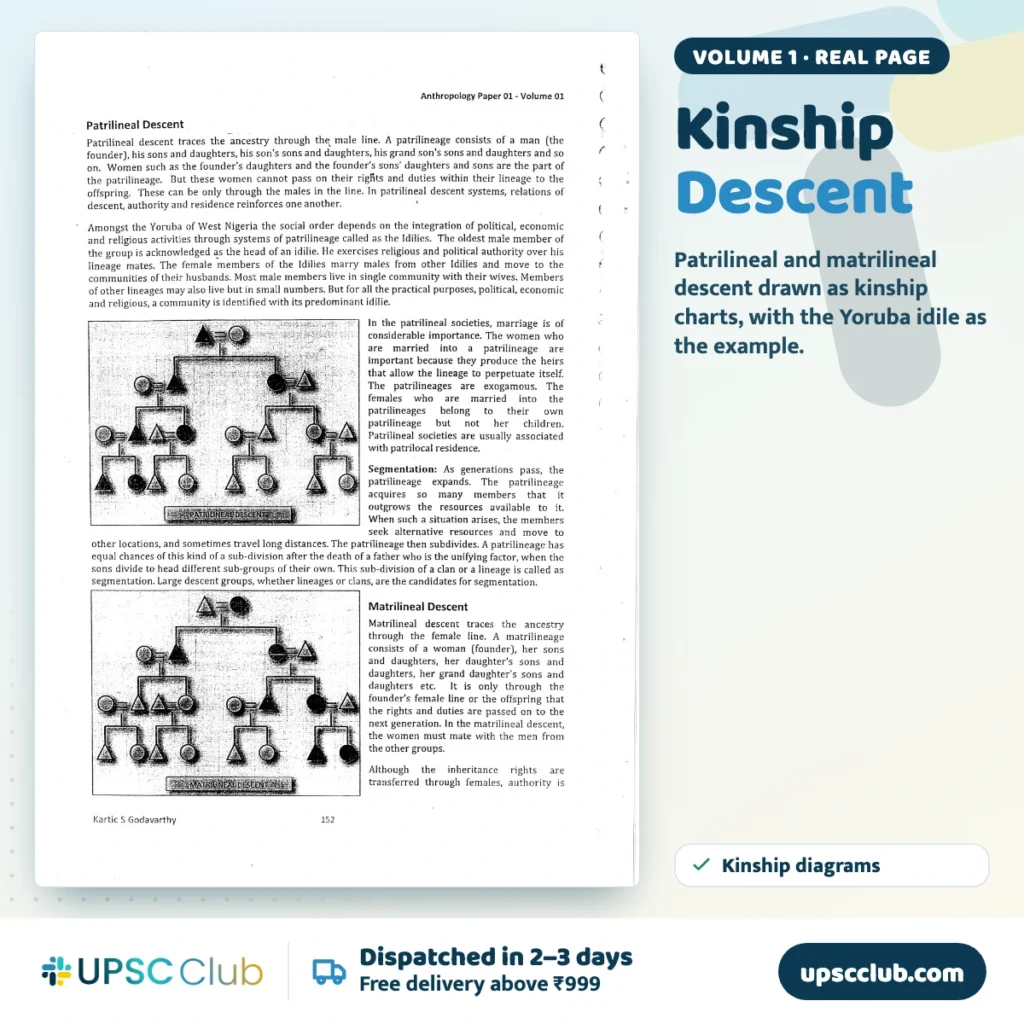
The bulk of the book is social anthropology: the nature of culture and society, marriage, family and kinship (descent, kinship terminology, alliance), economic organisation, political organisation and social control, religion, magic and witchcraft, culture, language and communication, and research methods. The kinship section has full descent charts, which is the part most aspirants struggle to draw from memory.
Volume 2 – Paper I, physical anthropology (285 pages)
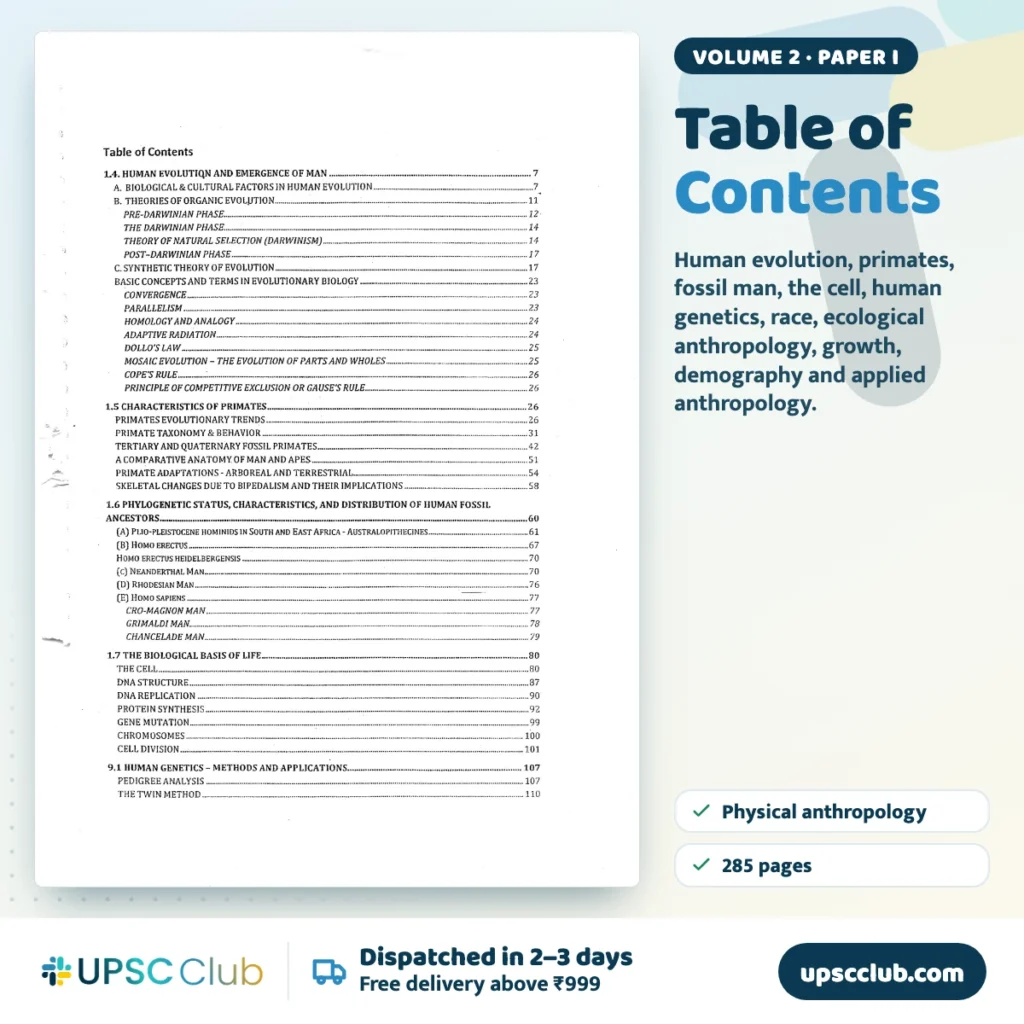
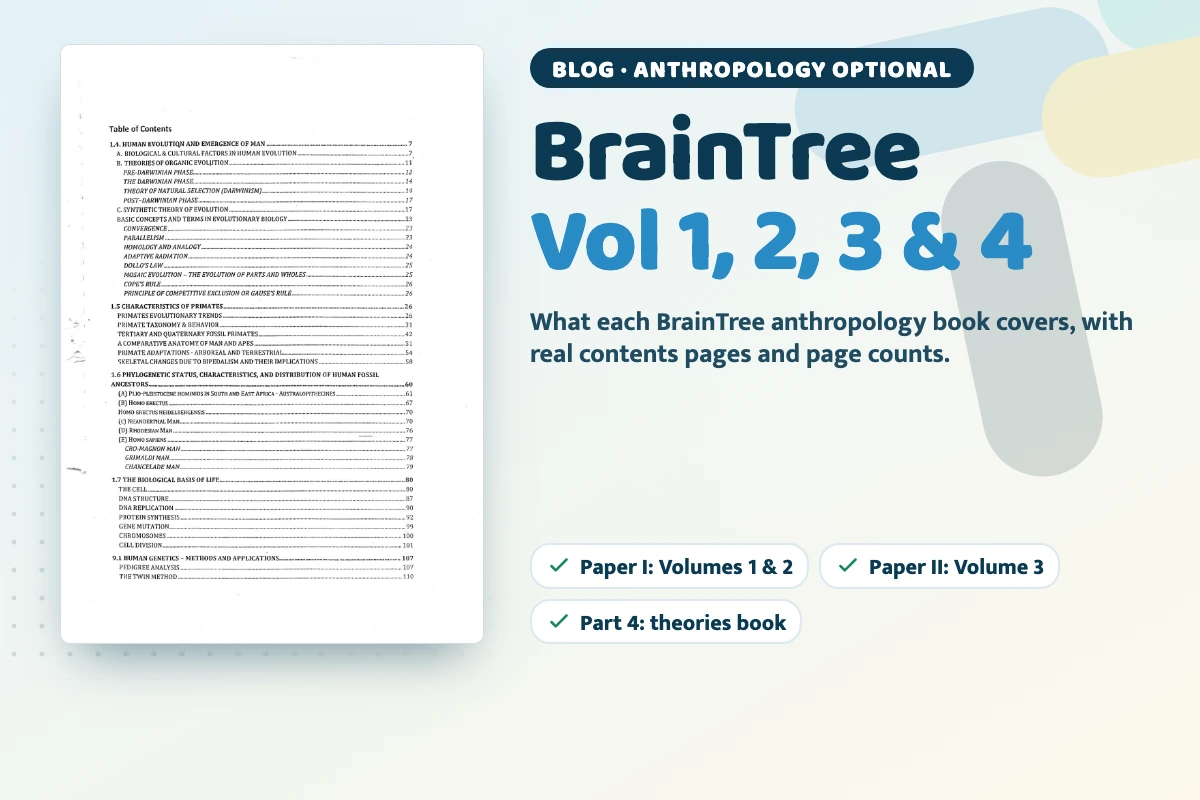
This is the volume people mean when they search for BrainTree physical anthropology or Brain Tree anthropology volume 2. It covers human evolution and the theories of organic evolution, the characteristics of primates and the comparative anatomy of man and apes, and fossil man from the Australopithecines to Homo erectus, Neanderthal man and Homo sapiens.
The second half is the biology that non-science aspirants fear: the cell, DNA and chromosomes, cell division, Mendelian genetics, Hardy-Weinberg equilibrium and chromosomal aberrations. After that come race and racism, ecological and epidemiological anthropology, human growth and development, social demography, and the applications of anthropology (forensic, sports, nutritional and genetic counselling).

Volume 3 – Paper II, Indian anthropology (368 pages)
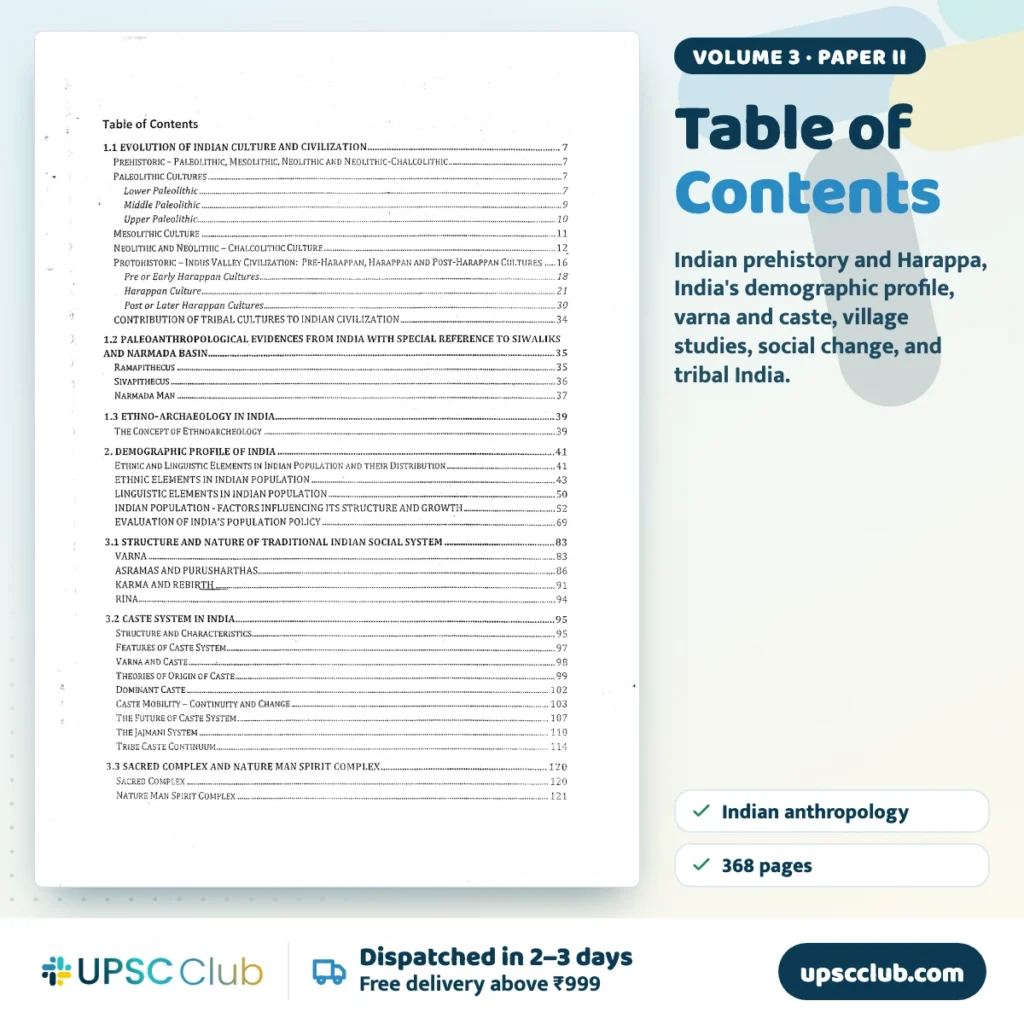
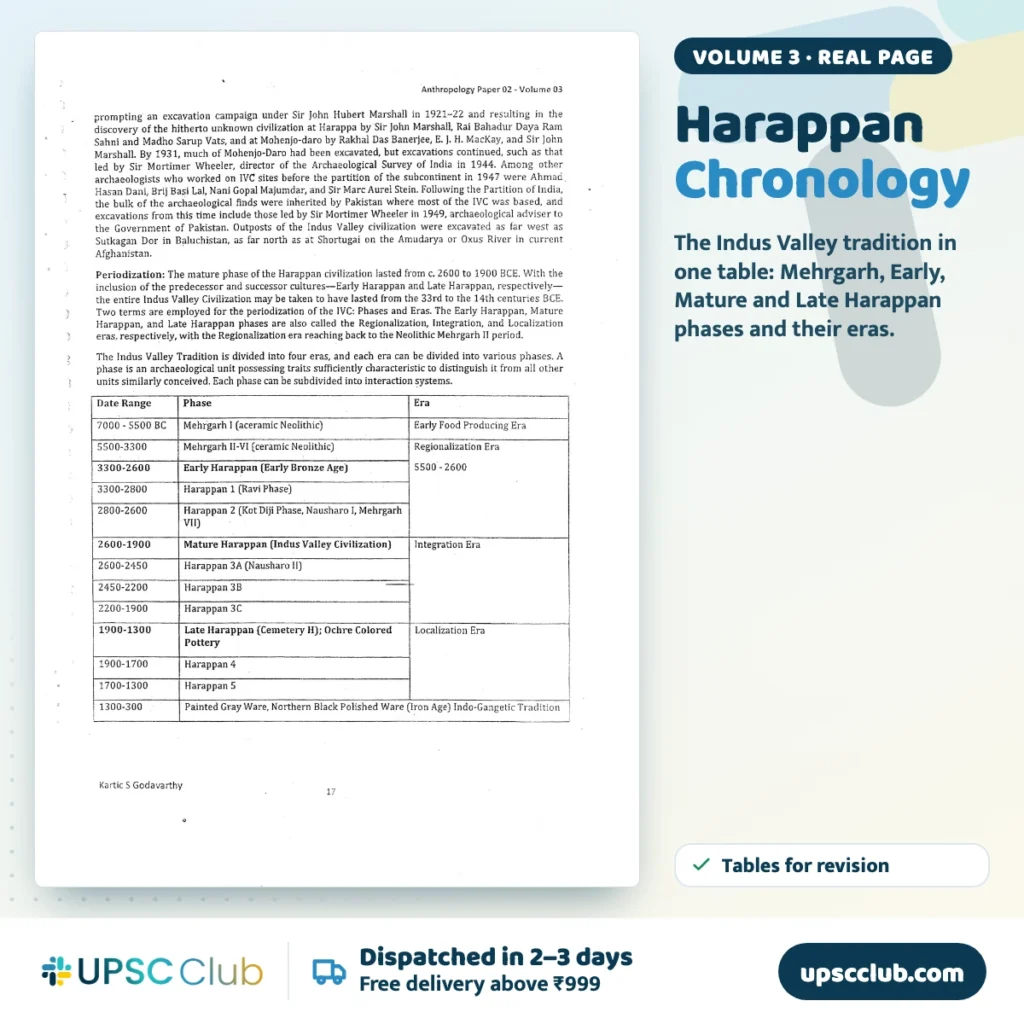
Volume 3 is the whole of Paper II in one book, and the one people search as Brain Tree anthropology volume 3. It starts with the evolution of Indian culture and civilisation: the prehistoric cultures, the Harappan civilisation, palaeo-anthropological evidence from the Siwaliks and the Narmada basin, and ethno-archaeology.
It then covers India’s demographic profile, varna, ashrama, purushartha and the caste system, the sacred complex and the nature-man-spirit complex, the impact of Buddhism, Jainism, Islam and Christianity, the growth of anthropology in India and village studies. The final third is tribal India: the tribal situation and problems of tribal communities, constitutional safeguards, ethnicity and tribal movements, tribal administration and development, and the role of anthropology in understanding regionalism and communalism.
Part 4 – the anthropological theories book (90 pages)
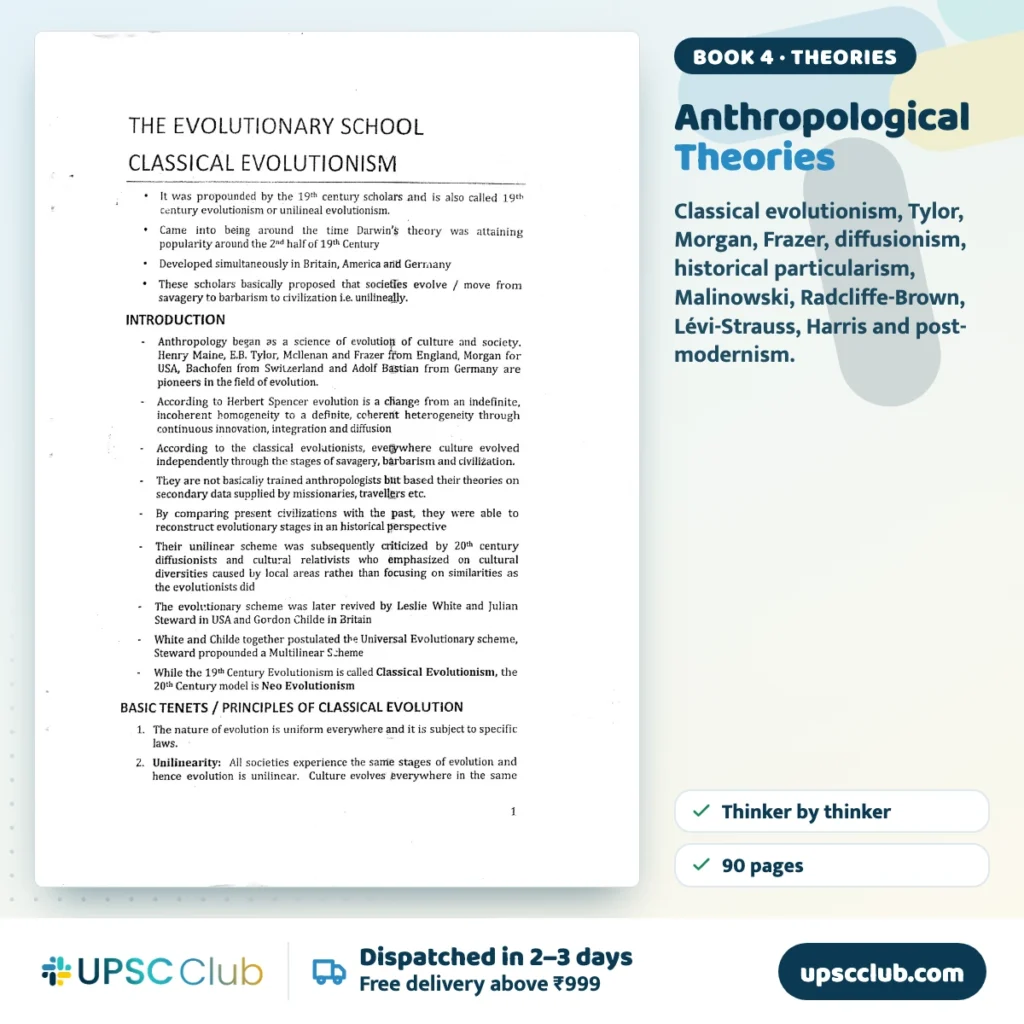
Many sellers call this booklet Part 4 or Volume 4, which is why searches like “braintree anthropology pdf part 4” exist. It is a thinker-by-thinker treatment of unit 6 of Paper I: classical evolutionism (Tylor, Morgan, Frazer), diffusionism, historical particularism, Malinowski’s functionalism, Radcliffe-Brown’s structural functionalism, neo-evolutionism, Lévi-Strauss’s structuralism, Marvin Harris’s cultural materialism, culture and personality, cognitive anthropology, symbolic and interpretive theories, and post-modernism.
Read it next to the theories chapter of Volume 1. Volume 1 gives the overview; this book gives each thinker enough room that you can quote the right name and the right concept in a 15-marker.
Where the BrainTree volumes fall short today
BrainTree built its reputation by covering every line of the syllabus, and the volumes above show that. But four things are worth knowing before you rely on them alone:
- No edition year is printed. You cannot tell from the books when the material was last revised, so recent schemes, data and committee reports have to come from somewhere else.
- The pages are photocopies. The volumes are reproduced from typed originals, and some diagrams (the descent charts above, for example) are grainy. You will redraw most of them yourself.
- Paper II needs fresh examples. Volume 3 explains the concepts well, but a 250-mark Paper II today rewards recent case studies, ethnographies and government data in every answer.
- Previous year questions are not built in. You will need a separate topic-wise PYQ collection to see how each unit is actually asked.
We cover these limits in more depth in our review, Are BrainTree anthropology notes still relevant or outdated?
Our recommendation: LotusArise anthropology notes
If you are choosing your main material now, we recommend the LotusArise IAS Anthropology Optional Complete Notes. They cover the same syllabus in the same order as BrainTree’s three volumes, but they are written for the exam as it is set today:
- 4 volumes, 2,159 pages, 87 chapters: Paper I Part A socio-cultural (722 pages), Paper I Part B physical and archaeological (646 pages), Paper II Part A Indian civilisation and society (432 pages), Paper II Part B tribal India (359 pages)
- 458 diagrams across both papers, from kinship charts and fossil skulls to growth curves and the Cernea model
- Previous year questions at the end of every chapter, plus a free PYQ book with 1,855 questions arranged topic-wise from 1981 to 2026 and all 26 full papers from 2014 to 2026
- A topic map on every chapter opener and a revision grid at the end of every chapter
- Printable A4 PDFs; the download links are emailed as soon as the payment clears
If you only need one paper, LotusArise also sells Paper 1 and Paper 2 separately.
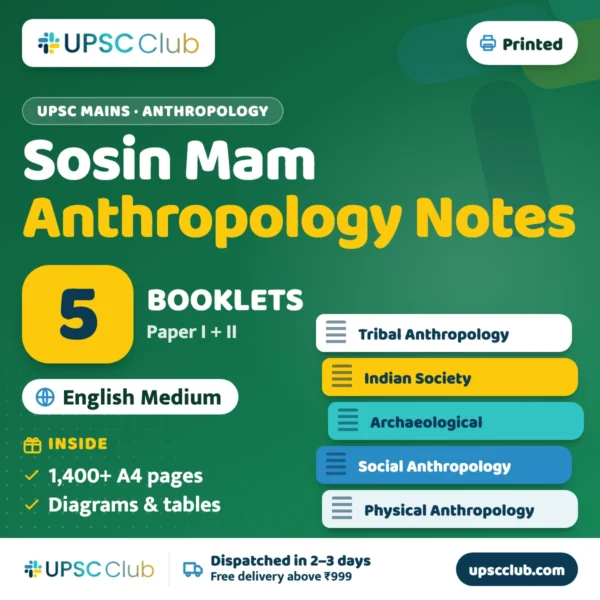
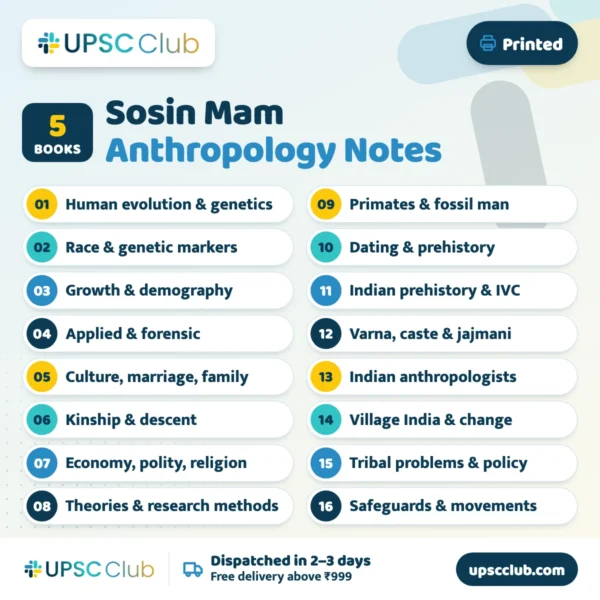
Already prefer printed books, or want the classic BrainTree set as a second reference? You can buy the BrainTree anthropology printed notes online: all four books shown on this page, couriered across India. For a side-by-side look at the three main options, read BrainTree vs Sosin Mam vs LotusArise anthropology notes.
Frequently asked questions
Which BrainTree volume is for Paper II?
Volume 3. Volumes 1 and 2 are both Paper I: Volume 1 is socio-cultural anthropology and Volume 2 is physical anthropology.
Does BrainTree Volume 2 cover physical anthropology?
Yes. Volume 2 covers evolution, primates, fossil man, the cell, human genetics, race, human growth, demography and applied anthropology.
What is BrainTree anthropology Part 4?
It is the separate 90-page book on anthropological theories (Paper I, unit 6), from classical evolutionism to post-modernism. Some sellers call it Volume 4.
How many pages are the BrainTree anthropology notes?
A little over 1,000 A4 pages: Volume 1 has 339, Volume 2 has 285, Volume 3 has 368 and the theories book has 90.
Which is the latest edition of BrainTree anthropology?
The books carry no edition year, so no seller can honestly promise a dated “latest edition”. Check the contents pages (shown above) against the current syllabus, and add recent data from another source.
Are the BrainTree volumes enough for 300+?
They cover the syllabus, but on their own they lack recent Paper II examples and topic-wise PYQs. Most high scorers pair a base set with PYQs and case studies; see our guide to topic-wise solved PYQs for anthropology and the top case studies for Paper 2.



Join Our WhatsApp Channel
Get instant updates – Free and Premium Study Materials.
Join Our Telegram Channel
Exclusive PDFs, MCQs, Current Affairs and Study Materials.