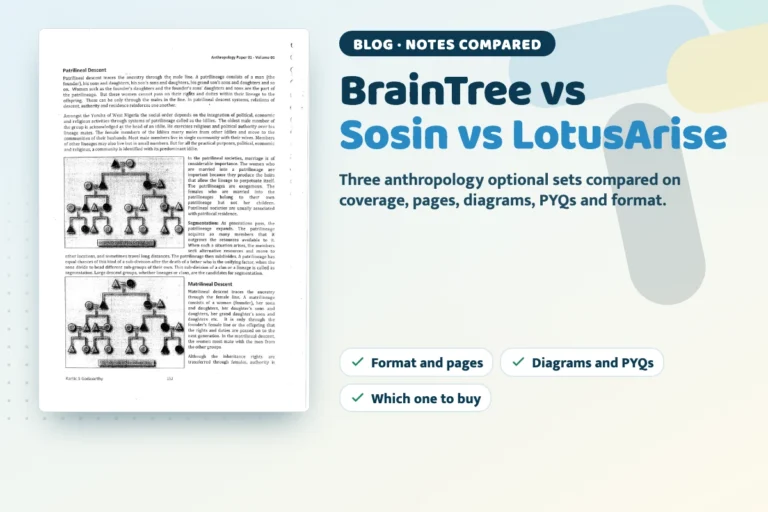
“In UPSC Anthropology Paper 1, a candidate who draws a clean, anatomically labeled diagram will consistently score 2 to 3 marks higher on every question than a candidate who writes two extra pages of text. Over a 250-mark paper, that difference alone creates a 30-mark rank-determining swing.”
UPSC CSE Anthropology Toppers’ Consensus
Drawing clear, accurate, and easily reproducible diagrams is the single highest-return skill you can develop for Anthropology optional Paper 1. Because Paper 1 deals extensively with human evolution, comparative primate anatomy, prehistoric archaeology, and population genetics, evaluators actively look for visual proof of scientific understanding.
However, most aspirants struggle with diagrams: medical textbooks like Gray’s Anatomy or advanced physical anthropology treatises contain illustrations that are far too complex to draw within an 8-minute exam window. Finding clean, high-yield diagrams for anthropology optional that can be sketched in under 90 seconds is crucial for securing a 160+ score in Paper 1.
In this master visual guide, we catalog the five non-negotiable diagram categories, outline essential labelling rules, and explain how LotusArise IAS Anthropology Master Notes provides print-ready diagrammatic vaults in every chapter.
The 5 High-Yield Diagram Categories for Paper 1
Every serious aspirant must prepare a personal visual bank covering these five essential domains:
1. Comparative Primate Anatomy (Man vs. Anthropoid Apes)
- Cranial Vault & Facial Skeleton: Compare Gorilla vs. Modern Human skull profiles. Key labels: Supraorbital torus (brow ridge), sagittal crest, nuchal crest, prognathism vs. orthognathism, mental protuberance (chin), and foramen magnum position (posterior vs. anterior/central).
- Dental Arcade: U-shaped / rectangular arcade with diastema (apes) vs. parabolic dental arcade with closed dentition (modern humans).
2. Bipedal Locomotion Adaptations
- Pelvis Evolution: Long, narrow ilium in quadrupeds vs. short, broad, laterally flared iliac blade in bipeds (accommodating gluteus medius/minimus for lateral stability).
- Vertebral Column & Femur: Single C-curve spine (apes) vs. S-shaped double curvature (cervical and lumbar lordosis in humans); straight femur vs. carrying angle / bicondylar valgus angle.
- Foot Architecture: Flat, divergent grasping hallux (opposable big toe in apes) vs. non-opposable big toe with longitudinal and transverse arches (shock absorption in humans).
3. Fossil Hominid Skulls (Phylogenetic Series)
- Australopithecus afarensis / africanus: Sub-nasal prognathism, small cranial capacity (~400–450 cc), post-orbital constriction.
- Homo erectus (Pekinensis / Javanicus): Platycephalic cranium, thick skull bones, prominent supraorbital torus, sagittal keel, occipital torus (~900–1000 cc).
- Neanderthal Man (Classic): Occipital bun (chignon), large midfacial projection, taurodontism in molars, massive brow ridge, large braincase (~1450 cc).
- Cro-Magnon (Homo sapiens): High vertical forehead, rounded occiput, prominent chin, reduced brow ridge (~1600 cc).
4. Prehistoric Archaeology Tool Typologies
- Lower Palaeolithic: Oldowan chopper/chopping tools; Acheulian bifacial handaxe and cleaver (flaking techniques).
- Middle Palaeolithic: Levallois prepared-core technique; Mousterian flake points, scrapers, and borers.
- Upper Palaeolithic & Mesolithic: Blade and burin industry; microliths (geometric: trapeze, triangle, lunate; non-geometric).
5. Human Genetics & Pedigree Charts
- Standard Pedigree Notations: Squares (males), circles (females), shaded (affected), double lines (consanguineous mating).
- Inheritance Patterns: Autosomal dominant (Huntington’s), autosomal recessive (Sickle-cell, Tay-Sachs), X-linked recessive (Hemophilia, Color blindness).
- Chromosomal Aberrations: Karyotypes of Down syndrome (Trisomy 21), Turner syndrome (45, XO), and Klinefelter syndrome (47, XXY).
The Four Golden Rules of Exam Diagramming
- Keep It Under 90 Seconds: Simplify anatomical contours into clean, recognizable line sketches rather than artistic shaded portraits.
- Always Box and Label Clearly: Enclose every diagram inside a clean rectangle, write a bold title underneath (e.g., Figure: Lateral Skull Profile Comparing Gorilla and Modern Human), and draw horizontal pointer lines for labels.
- Integrate with Surrounding Text: Never let a diagram float without reference. In your paragraph, explicitly write: “As illustrated in the diagram below, the anterior migration of the foramen magnum reflects the shift to bipedalism…”
- Maintain Anatomical Proportions: Ensure the cranial vault-to-facial skeleton ratio is accurate (apes have large facial skeletons and small vaults; humans have large vaults and small retracted faces).
How LotusArise IAS Master Notes Delivers a Pre-Made Visual Vault
Unlike coaching photocopies with illegible blackboard scrawls, LotusArise IAS Anthropology Master Notes embeds 4 to 6 print-quality, exam-ready diagrams into every single chapter across Paper 1:
- Every anatomical, fossil, and stone tool sketch is drawn to exact scientific proportions and formatted specifically for rapid UPSC answer reproduction.
- Each chapter features a dedicated “Diagrams to Master” checklist, making pre-exam revision seamless.
Explore full sample chapters and diagrams on the official LotusArise Anthropology Store or read our complete strategy on How to Prepare Paper 1 for Anthropology Optional.







Join Our WhatsApp Channel
Get instant updates – Free and Premium Study Materials.
Join Our Telegram Channel
Exclusive PDFs, MCQs, Current Affairs and Study Materials.