

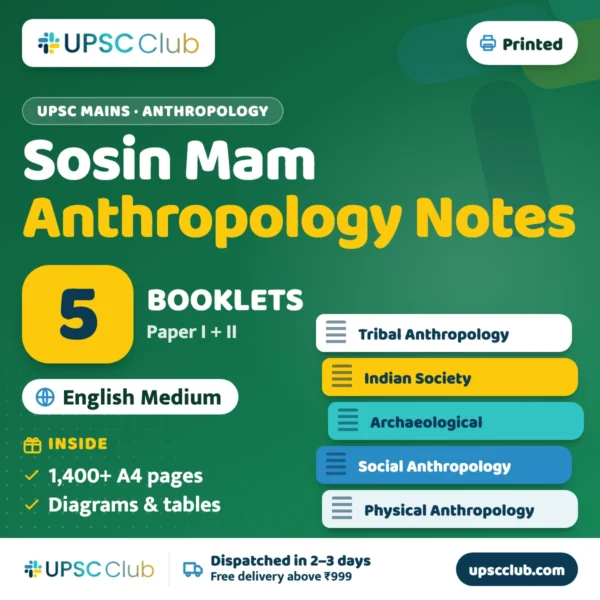
The Sosin Mam anthropology notes are one of the best-known printed sets for the UPSC anthropology optional, yet most listings only say “5 booklets” without telling you what each one contains. If you are searching for the Sosin anthropology books or study material, this guide shows you exactly what you get.
We went through a complete printed set page by page. Below you will find what each of the five books covers, its page count, the syllabus chapters it maps to and its real index page. At the end we explain where the set falls short for today’s Mains and what we recommend.
Who wrote the Sosin anthropology notes?
Every book opens with a foreword signed by Mrs. Sosin Thayyaba Revella, faculty in anthropology at Sosin Classes, Hyderabad. The foreword says the booklets are compiled from standard textbooks and journal articles, and are meant to be used together with class discussion and class notes. Keep that in mind: they are a compact reading set, not a standalone textbook.
Sosin Mam anthropology books at a glance
| Book | Paper | Pages | Syllabus chapters |
|---|---|---|---|
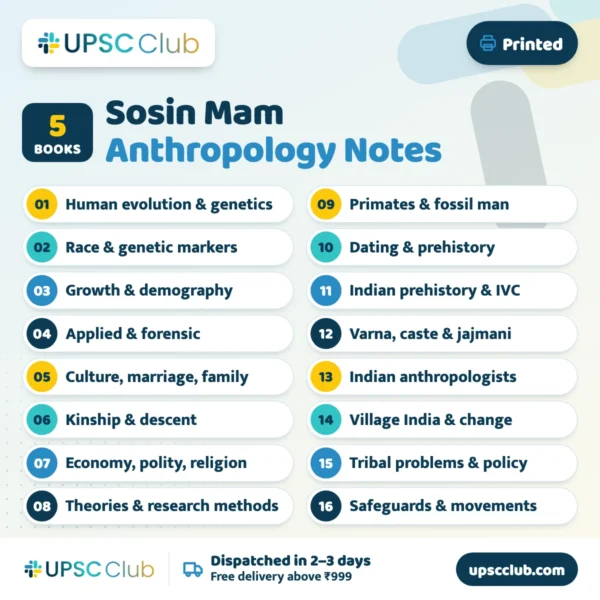
| Book 1 – Physical Anthropology | Paper I | 330 | 1.4, 1.7, 9 to 12: evolution, the cell, genetics, race, genetic markers, ecology, growth, demography, applied |
| Book 2 – Social Anthropology | Paper I | 225 | 1.2, 1.3, 2 to 8: disciplines, culture, marriage, family, kinship, economy, polity, religion, theories, language, methods |
| Book 3 – Archaeological Anthropology & Indian Archaeology | Paper I + II | 222 | Paper I 1.1, 1.5, 1.6, 1.8 and Paper II 1.1 to 1.3: primates, fossils, dating, Indian prehistory, Harappa |
| Book 4 – Indian Society | Paper II | 297 | 3 to 5: varna and caste, Indian anthropologists, village India |
| Book 5 – Tribal Anthropology | Paper II | 372 | 6 to 9: tribal situation, problems, deprived classes, movements, development |
That is just over 1,400 A4 pages in all. Each book has its own index with the syllabus chapter and page number of every topic.
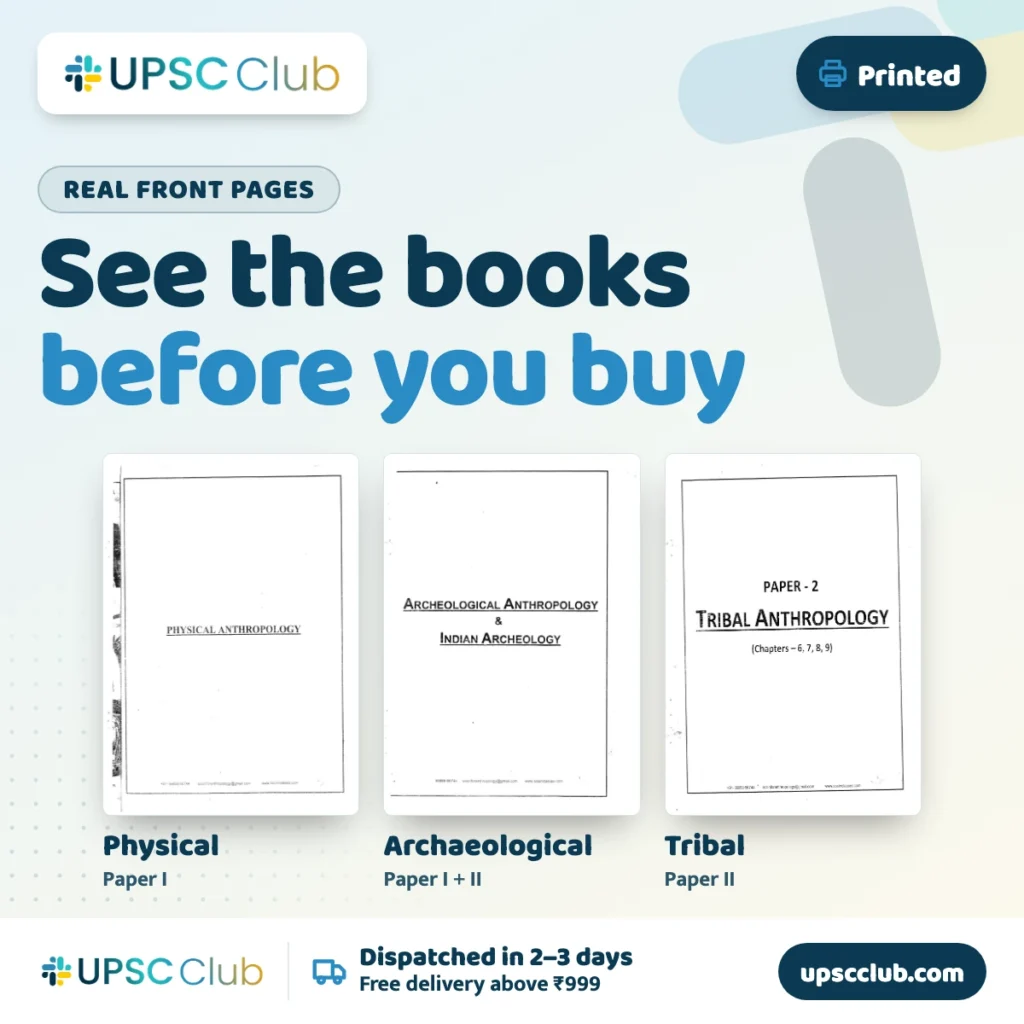
Book 1 – Physical Anthropology (Paper I, 330 pages)
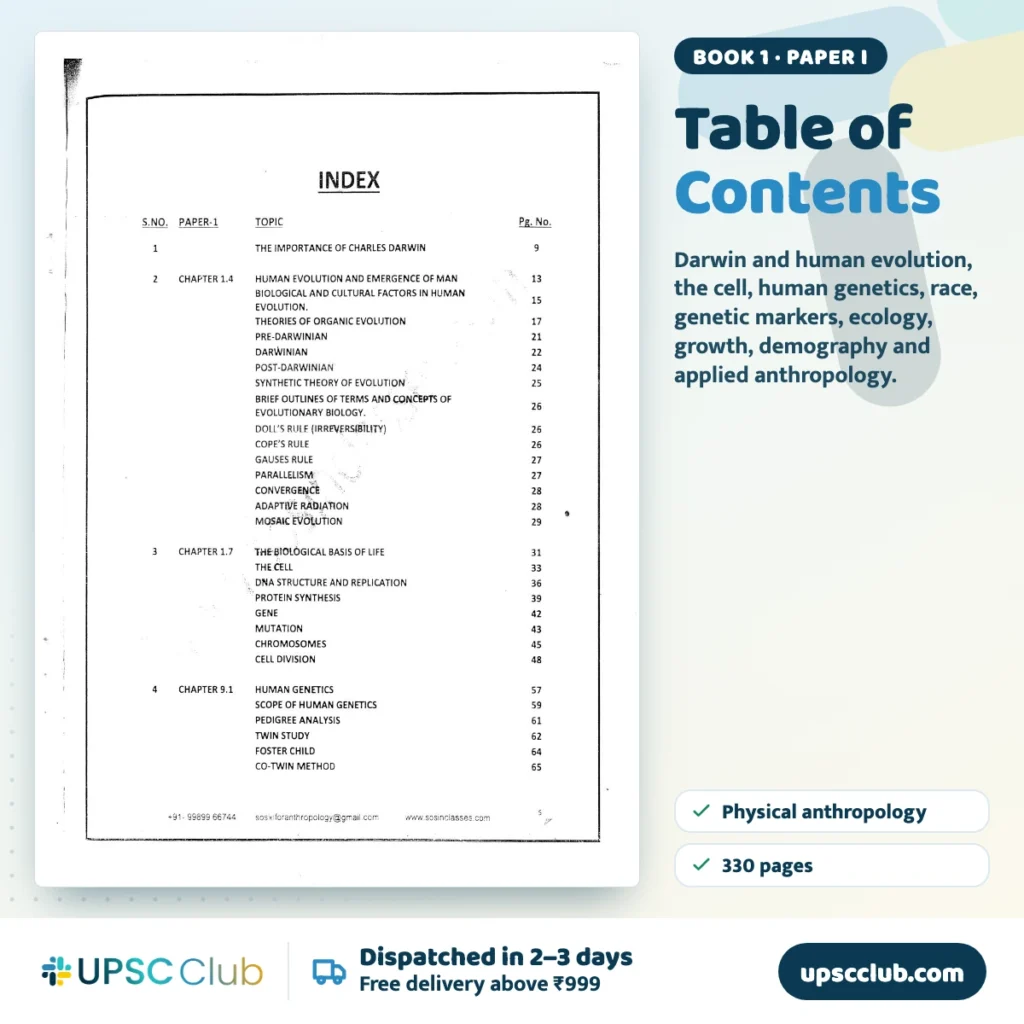
The largest Paper I book. It opens with the importance of Charles Darwin and moves through human evolution and the theories of organic evolution (pre-Darwinian, Darwinian and the synthetic theory, plus Dollo’s, Cope’s and Gause’s rules), then the biological basis of life: the cell, DNA, protein synthesis, chromosomes and cell division.
The second half is human genetics: pedigree, twin and foster-child methods, Mendelian and population genetics, the Hardy-Weinberg law, chromosomal aberrations and syndromes, race and racial criteria, and genetic markers such as ABO, Rh and HLA. It ends with ecological and epidemiological anthropology, human growth and development, demographic anthropology and applied physical anthropology (forensics, sports, nutrition, the military and anthropometric design).
Book 2 – Social Anthropology (Paper I, 225 pages)
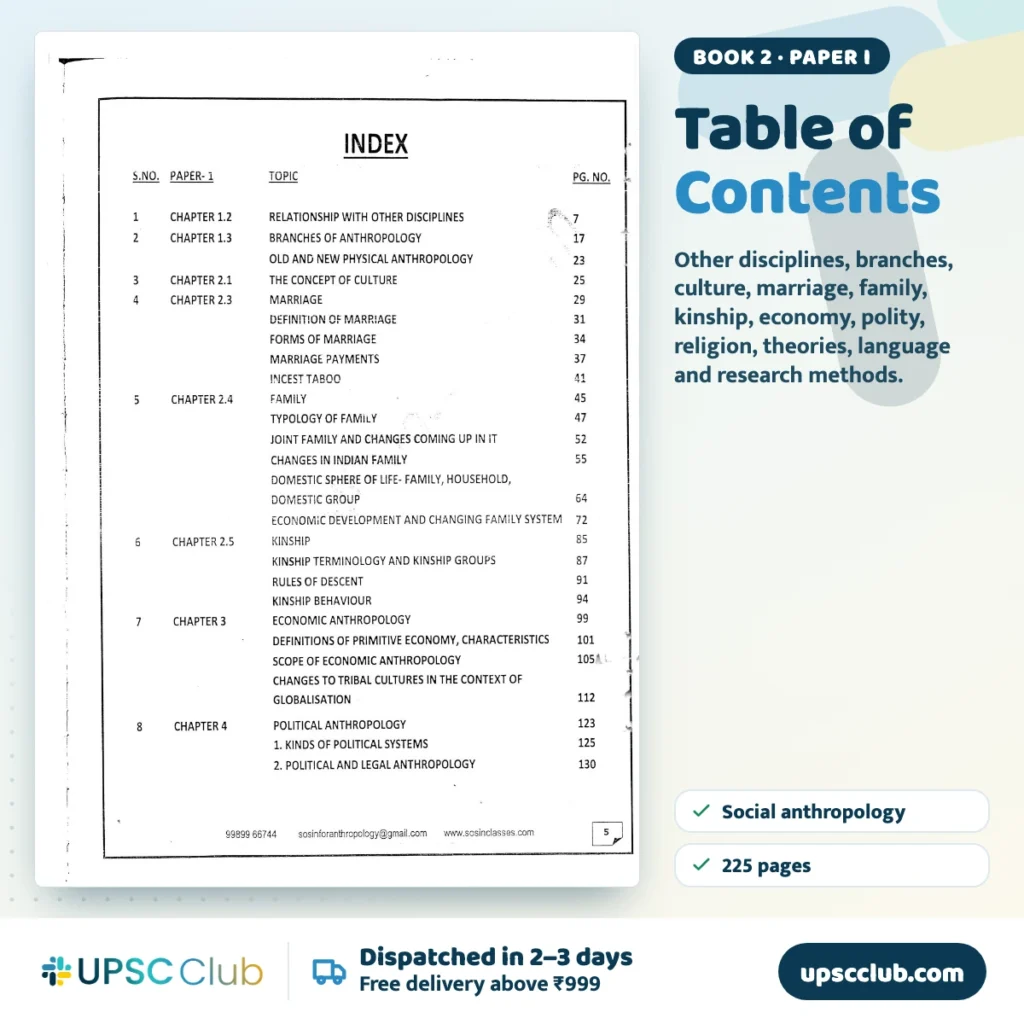
The socio-cultural core of Paper I: anthropology’s relationship with other disciplines and its branches, the concept of culture, marriage (forms, marriage payments, incest taboo), family (typology, the joint family and its changes) and kinship (terminology, rules of descent, kinship behaviour).
It continues with economic anthropology, political and legal anthropology, religion, magic and science, and a theories chapter covering Boas and Malinowski, Durkheim and functionalism, Mary Douglas, Schneider, cultural materialism, Ralph Linton and modal personality. Linguistic anthropology and research methods close the book.
Book 3 – Archaeological Anthropology and Indian Archaeology (Paper I and II, 222 pages)
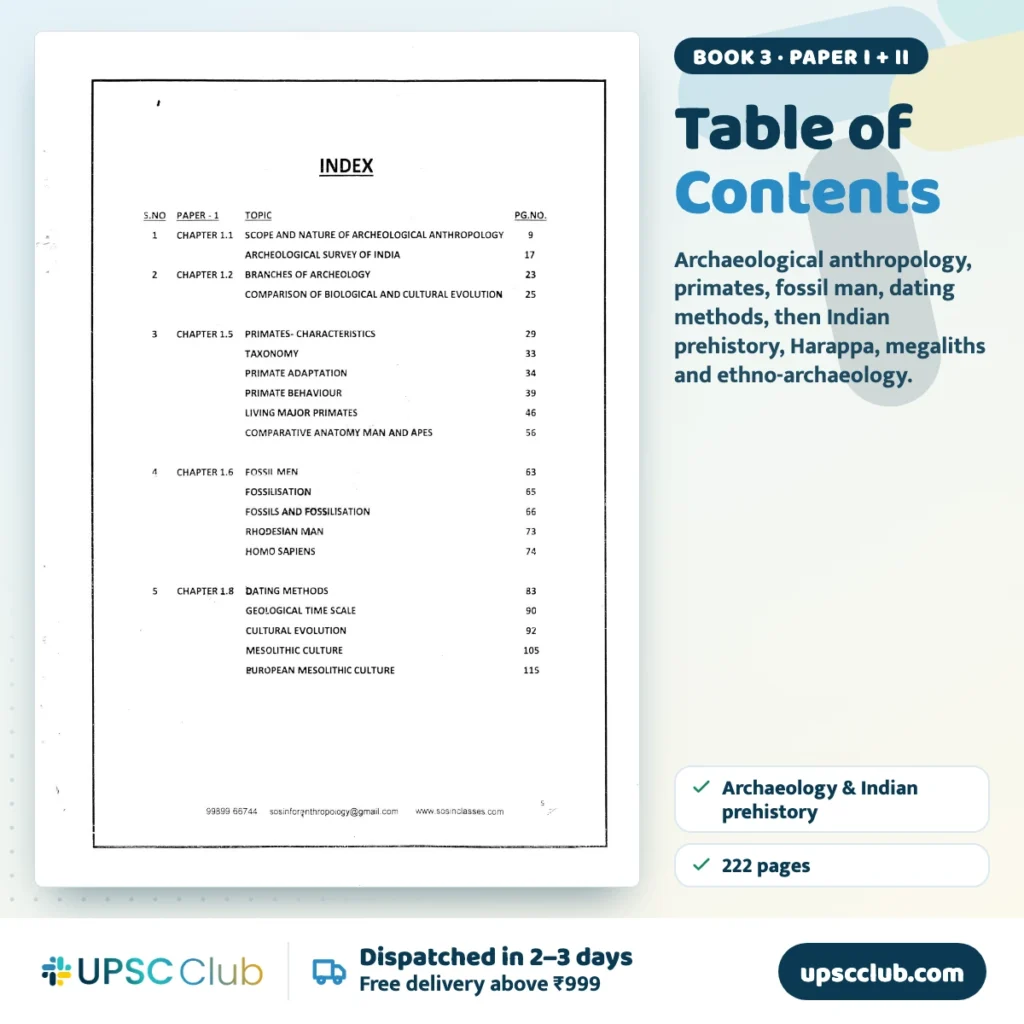
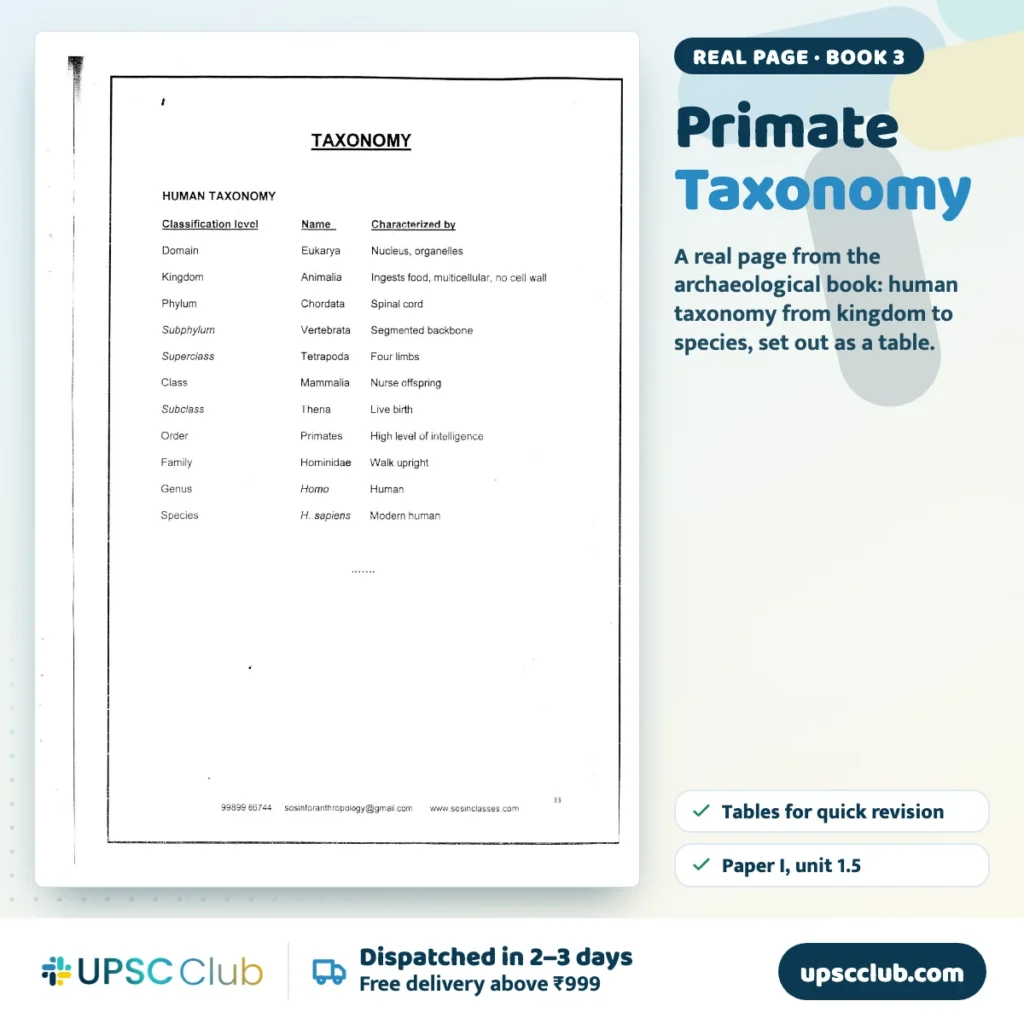
This book bridges both papers. For Paper I it covers the scope of archaeological anthropology and the Archaeological Survey of India, the branches of archaeology, primates (characteristics, taxonomy, adaptation, behaviour, living major primates and the comparative anatomy of man and apes), fossil men, dating methods, the geological time scale, cultural evolution and the Mesolithic.
For Paper II it covers Indian prehistory: the Palaeolithic, prehistoric art, the Mesolithic and Sohanian cultures, megaliths, the Neolithic revolution and the Neolithic of North-East India, the Indus Valley civilisation, Chalcolithic cultures, H.D. Sankalia and N.K. Bose, Dryopithecus, Sivapithecus and Ramapithecus, Homo sapiens studies in India and ethno-archaeology.
Book 4 – Indian Society (Paper II, 297 pages)
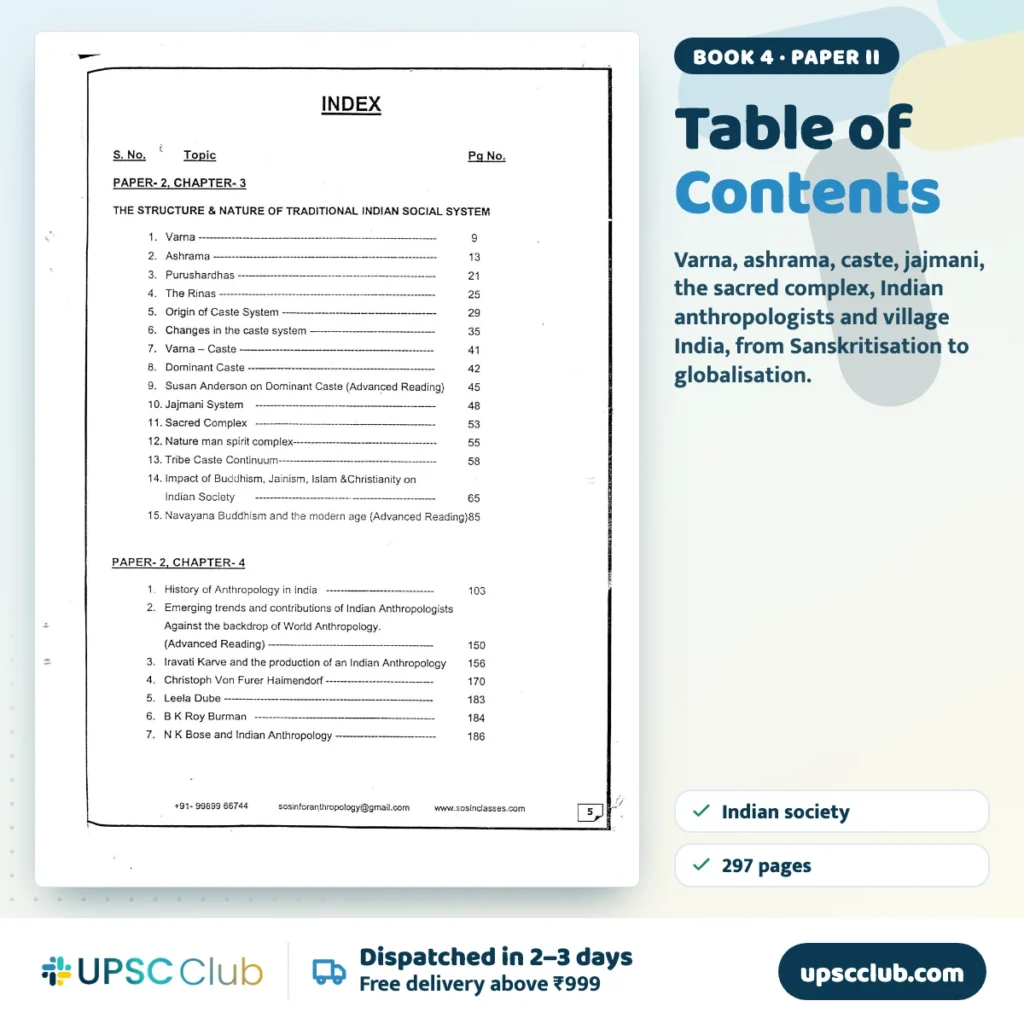
Chapters 3 to 5 of Paper II. It covers varna, ashrama, purusharthas and rinas, the origin of caste and changes in the caste system, dominant caste and the jajmani system, the sacred complex, the nature-man-spirit complex and the tribe-caste continuum, and the impact of Buddhism, Jainism, Islam and Christianity on Indian society.
It then covers the history of anthropology in India and its leading figures (Iravati Karve, Haimendorf, Leela Dube, B.K. Roy Burman, N.K. Bose), and village India: agrarian structure, Sanskritisation, modernisation and westernisation, religious and linguistic minorities, economic development, globalisation and mass media.
Book 5 – Tribal Anthropology (Paper II, 372 pages)
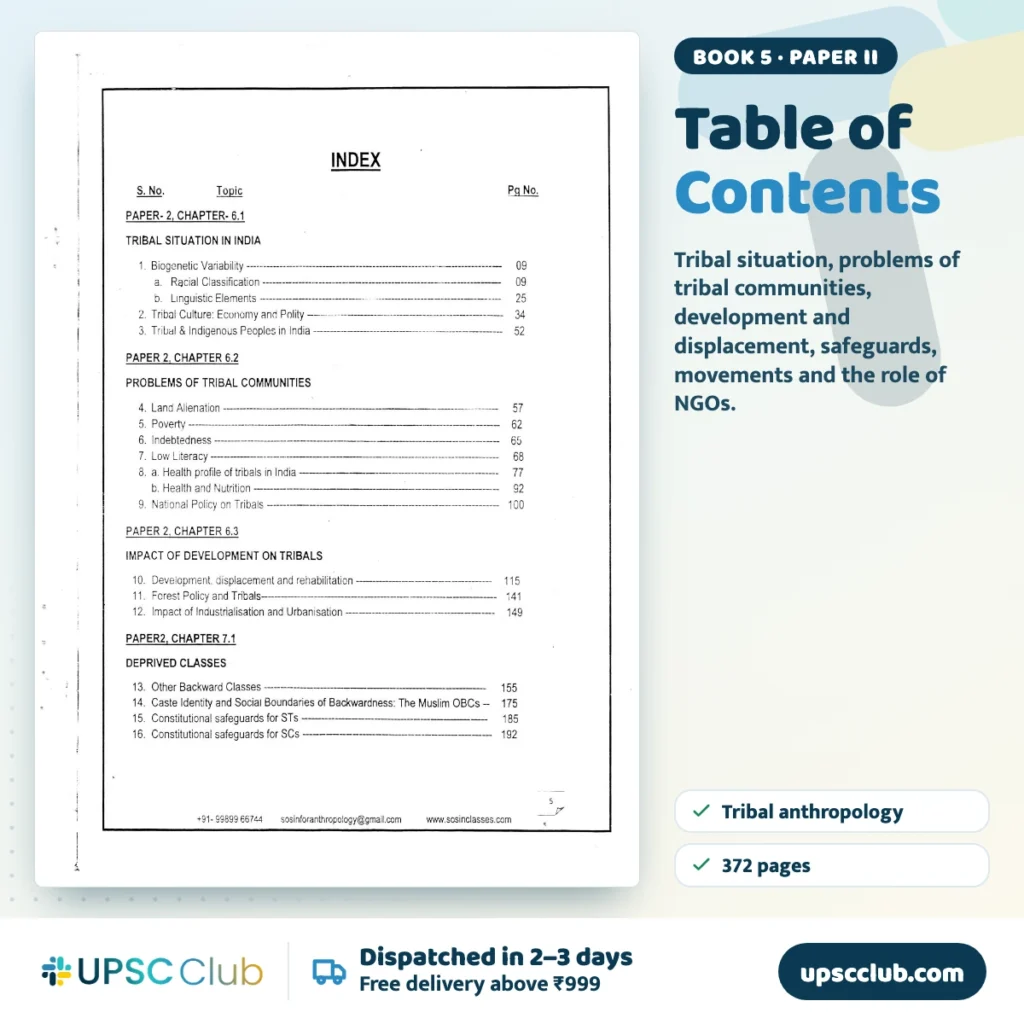
The largest book in the set, covering chapters 6 to 9 of Paper II: the tribal situation in India, the problems of tribal communities (land alienation, poverty, indebtedness, low literacy, health and nutrition), the national policy on tribals, development and displacement, forest policy, industrialisation and urbanisation.
It continues with deprived classes and the constitutional safeguards for STs and SCs, tribal social change, TRIFED and the commodification of tribes, ethnicity and tribal movements, the impact of other religions on tribals, tribe and nation state, the role of NGOs and of anthropology in tribal and rural development, and regionalism, nationalism, tribal art and national integration.
Where the Sosin books fall short today
- Not meant to stand alone. The foreword itself says the booklets are to be used with class discussion and class notes. If you are studying on your own, you will need a fuller source alongside.
- No previous year questions. None of the five indexes lists a PYQ section, so you will need a separate topic-wise PYQ collection.
- No edition year is printed. Recent schemes, data and committee reports for Paper II have to come from elsewhere.
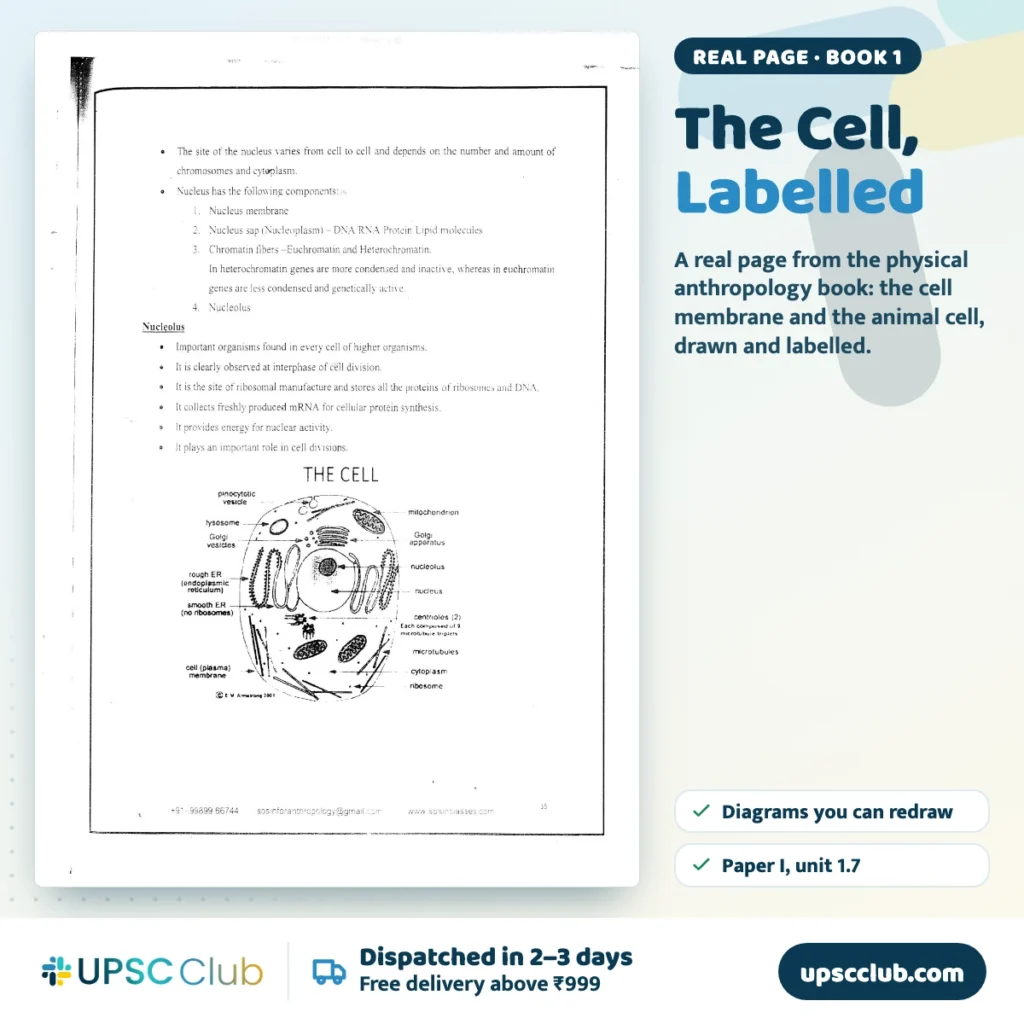
- Photocopied pages. The books are reproduced from typed originals, so diagrams are clear enough to learn from but you will redraw them yourself.
Our recommendation: LotusArise anthropology notes
If you are choosing your main material now, we recommend the LotusArise IAS Anthropology Optional Complete Notes. They cover the same syllabus as the five Sosin books, but as one self-contained course built for today’s exam:
- 4 volumes, 2,159 pages, 87 chapters: Paper I Part A socio-cultural (722 pages), Paper I Part B physical and archaeological (646 pages), Paper II Part A Indian civilisation and society (432 pages), Paper II Part B tribal India (359 pages)
- 458 diagrams across both papers, from kinship charts and fossil skulls to growth curves and the Cernea model
- Previous year questions at the end of every chapter, plus a free PYQ book with 1,855 questions arranged topic-wise from 1981 to 2026 and all 26 full papers from 2014 to 2026
- A topic map on every chapter opener and a revision grid at the end of every chapter
- Printable A4 PDFs; the download links are emailed as soon as the payment clears
If you only need one paper, LotusArise also sells Paper 1 and Paper 2 separately.
Prefer printed books, or follow Sosin Ma’am’s classes? You can buy the Sosin Mam anthropology printed notes online: all five books shown on this page, couriered across India. To compare all the main options, read BrainTree vs Sosin Mam vs LotusArise anthropology notes.
Frequently asked questions
How many books are in the Sosin Mam anthropology notes?
Five: Physical Anthropology, Social Anthropology, Archaeological Anthropology and Indian Archaeology, Indian Society, and Tribal Anthropology.
Which Sosin books are for Paper II?
Book 4 (Indian Society) and Book 5 (Tribal Anthropology), plus the Indian prehistory part of Book 3.
How many pages are the Sosin anthropology notes?
Just over 1,400 A4 pages: Physical 330, Social 225, Archaeological 222, Indian Society 297 and Tribal 372.
Are the Sosin Mam notes handwritten?
No. They are typed, printed booklets compiled by Mrs. Sosin Thayyaba Revella, not handwritten class notes.
Is Sosin Mam good for anthropology?
The books are compact and cover both papers, but they are designed to go with classes. We look at this question in detail in Is Sosin Mam good for anthropology?
Join Our WhatsApp Channel
Get instant updates – Free and Premium Study Materials.
Join Our Telegram Channel
Exclusive PDFs, MCQs, Current Affairs and Study Materials.