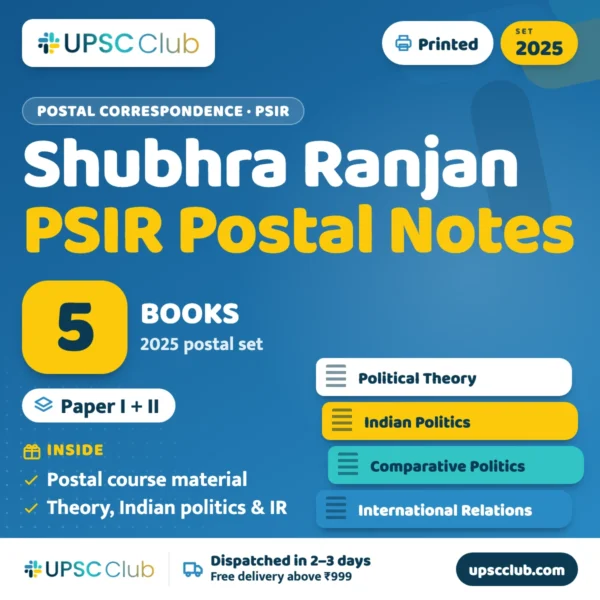
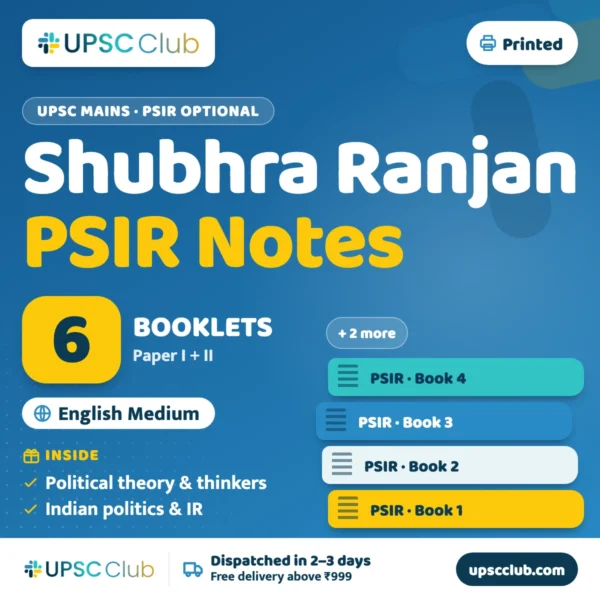
- Opt for PSIR if: You have an academic passion for international relations, foreign policy debates, and political theory, and have sufficient daily time to track global geopolitical news.
- Opt for Public Administration if: You prefer a disciplined, structured syllabus focused on real-world governance, want massive overlap with GS 2 and GS 4 Ethics, and seek an optional that can be mastered and revised quickly via synthesized resources like LotusArise IAS Master Notes.
“PSIR and Public Administration share the same political science parentage. Yet, while PSIR sweeps across global geopolitics and grand political philosophy, Public Administration zeroes in on the internal engine room of state delivery and civil bureaucracy.”
Comparative Optional Analysis, UPSC CSE Academy
For aspirants drawn to polity, governance, and state institutions, the choice almost always narrows down to two powerhouses: Public Administration versus Political Science and International Relations (PSIR).
Both optionals boast stellar track records of producing All India Rank 1 toppers. However, their day-to-day preparation requirements, syllabus volatility, current affairs maintenance burden, and evaluation dynamics are fundamentally distinct.
In this candid analysis, we dissect Public Administration versus PSIR to help you determine which optional best fits your academic strengths and timeline for UPSC 2026–2027.
Core Comparison Matrix: Pub Ad vs PSIR
| Comparison Factor | Public Administration Optional | PSIR Optional |
|---|---|---|
| Syllabus Size & Nature | Moderately compact; fixed core administrative theory + Indian administration | Substantially larger; Western/Indian political thought + Comparative politics + IR |
| Current Affairs Load | Moderate: Domestic governance reforms, committee reports (2nd ARC, NITI Aayog) | Extremely heavy: Daily evolving global geopolitics, bilateral ties, global summits |
| Static vs Dynamic Ratio | 70% Static (Theories, Thinkers, Structures) / 30% Dynamic | 50% Static (Thinkers, Theory) / 50% Highly Dynamic (IR Paper 2) |
| GS Overlap | Heavy synergy with GS 2 (Governance), GS 4 (Ethics), and GS 3 (Disaster/Economy) | Heavy synergy with GS 2 (Polity, Constitution & International Relations) and Essay |
| Revision Speed | Very fast before Mains (standardized thinker grids and reform matrices) | Time-intensive due to massive notes volume and evolving geopolitical updates |
| Risk Profile | Need to maintain academic Pub Ad terminology (avoiding generic GS tone) | Massive competition saturation; answer scripts tend to look identical |
1. Syllabus Volume and Daily Maintenance Burden
The single greatest differentiator between the two optionals is the dynamic current affairs burden. In PSIR, Paper 2 Part B (India and the World) is in perpetual flux. A candidate must track ongoing conflicts (Ukraine, Middle East), shifting Indo-Pacific alignments (Quad, AUKUS), multilateral summits (G20, SCO, BRICS), and bilateral relations with dozens of nations. Preparing comprehensive scholar perspectives on fast-breaking geopolitical developments requires at least 1.5 to 2 hours of daily reading right up to the week of Mains.
In Public Administration, by contrast, the syllabus is far more stable. Once you master the classical and modern thinkers (Taylor, Weber, Simon, Waldo, Riggs, Ostrom) and the institutional framework of Indian administration, your core notes remain valid for years. Current affairs updates are focused strictly on domestic governance mechanisms (lateral entry rules, Mission Karmayogi, CPGRAMS updates, 2nd ARC implementations).
2. Thinker Depth: Political Philosophers vs. Administrative Scientists
In PSIR, you must navigate grand normative philosophy—Plato, Aristotle, Machiavelli, Hobbes, Locke, Rousseau, Mill, Marx, Gramsci, and Hannah Arendt—debating questions of justice, liberty, equality, and sovereignty.
In Public Administration, thinkers are applied social scientists and organizational architects—Woodrow Wilson, Frederick Taylor, Henri Fayol, Max Weber, Mary Parker Follett, Chester Barnard, Herbert Simon, and Chris Argyris. Their theories deal directly with efficiency, decision-making, organizational pathology, leadership, motivation, and public accountability. For candidates with backgrounds in engineering, commerce, sciences, or management, administrative logic is far more intuitive and manageable than normative political theory.
Final Recommendation
- Opt for PSIR if: You have an academic passion for international relations, foreign policy debates, and political theory, and have sufficient daily time to track global geopolitical news.
- Opt for Public Administration if: You prefer a disciplined, structured syllabus focused on real-world governance, want massive overlap with GS 2 and GS 4 Ethics, and seek an optional that can be mastered and revised quickly via synthesized resources like LotusArise IAS Master Notes.


Join Our WhatsApp Channel
Get instant updates – Free and Premium Study Materials.
Join Our Telegram Channel
Exclusive PDFs, MCQs, Current Affairs and Study Materials.