
Ask any UPSC topper what separates a 90-mark Mains score from a 130-mark one, and very few will say “I studied harder.” The more common answer is this: the quality of sources I was reading. Good content doesn’t just give you facts — it gives you the analytical vocabulary, the policy framework, and the data points that turn an ordinary answer into one the examiner remembers.
The problem is that UPSC Mains preparation involves an almost overwhelming number of potential sources. Newspapers, magazines, government reports, international indices, coaching platforms, answer writing programmes — where do you even begin? And more importantly, what do you actually need versus what is just adding to the pile?
We’ve mapped this comprehensively. Not every source deserves equal time. What follows is a curated, honest breakdown of the best sources for UPSC Mains — what each is useful for, how to use it efficiently, and how to weave them together into a coherent answer writing strategy.

Newspapers: Your Daily Foundation
Newspapers are not supplementary reading for UPSC Mains — they are the backbone of current affairs integration, which now accounts for roughly 40% of the questions across all four GS papers. The key, however, is reading them analytically, not mechanically. You’re not a news reader; you’re an aspirant building a mental database of policy, governance, society, and economy.
The Hindu
thehindu.com — There is a reason nearly every UPSC topper mentions The Hindu. Its editorial page, particularly the Op-Ed section and signed columns, frequently addresses exactly the kind of complex, multi-dimensional governance and social issues that appear in Mains questions. The depth of analysis on foreign policy, social justice, environment, and constitutional matters is unmatched in Indian English journalism for UPSC purposes. Read it daily, and make short topic-wise notes, not running summaries.
The Hindu Strategy: Don’t read The Hindu like a newspaper — read it like a case study bank. When you see an editorial on, say, “fiscal federalism,” ask yourself: which GS paper does this belong to? What question could UPSC ask? What data points should I note? This habit turns passive reading into active preparation.
Indian Express
indianexpress.com — The Explained section and the Express columns by economists and policy analysts make Indian Express particularly valuable for GS2 (Governance, Polity, International Relations) and GS3 (Economy, Environment). Many aspirants use The Hindu for editorials and Indian Express for its crisp news coverage and the Explained series. You don’t need to read both cover-to-cover — be selective, but be consistent.
PIB (Press Information Bureau)
pib.gov.in — Massively underused by aspirants who don’t realise that PIB is essentially the government’s official position on every policy. If a Mains question asks about a scheme, a committee report, or a policy initiative, PIB gives you the authoritative government language — which is exactly what examiners are looking for. Spend 15–20 minutes daily on PIB releases. The language in government press releases often directly mirrors what gets full marks in Mains answers.
Magazines: Depth Where Newspapers Stop Short
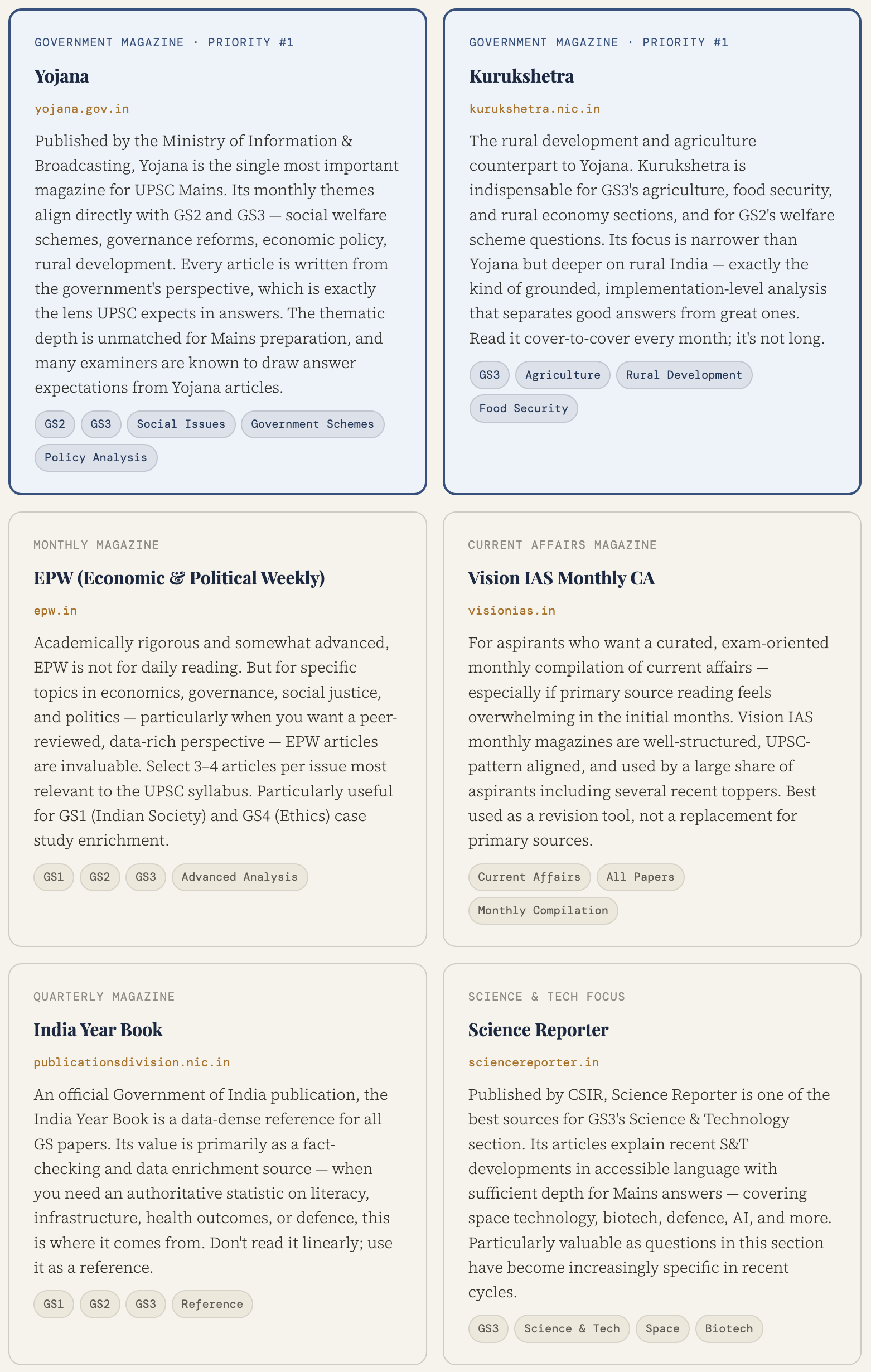
Magazines occupy a unique position in UPSC Mains preparation. Newspapers give you breadth; magazines give you depth. A newspaper report on MGNREGS might be 600 words. A Yojana article on the same topic might be 4,000 words with data, historical context, implementation challenges, and policy recommendations. That depth is what enriches Mains answers beyond surface-level responses.
Government Reports: The Authoritative Data Layer
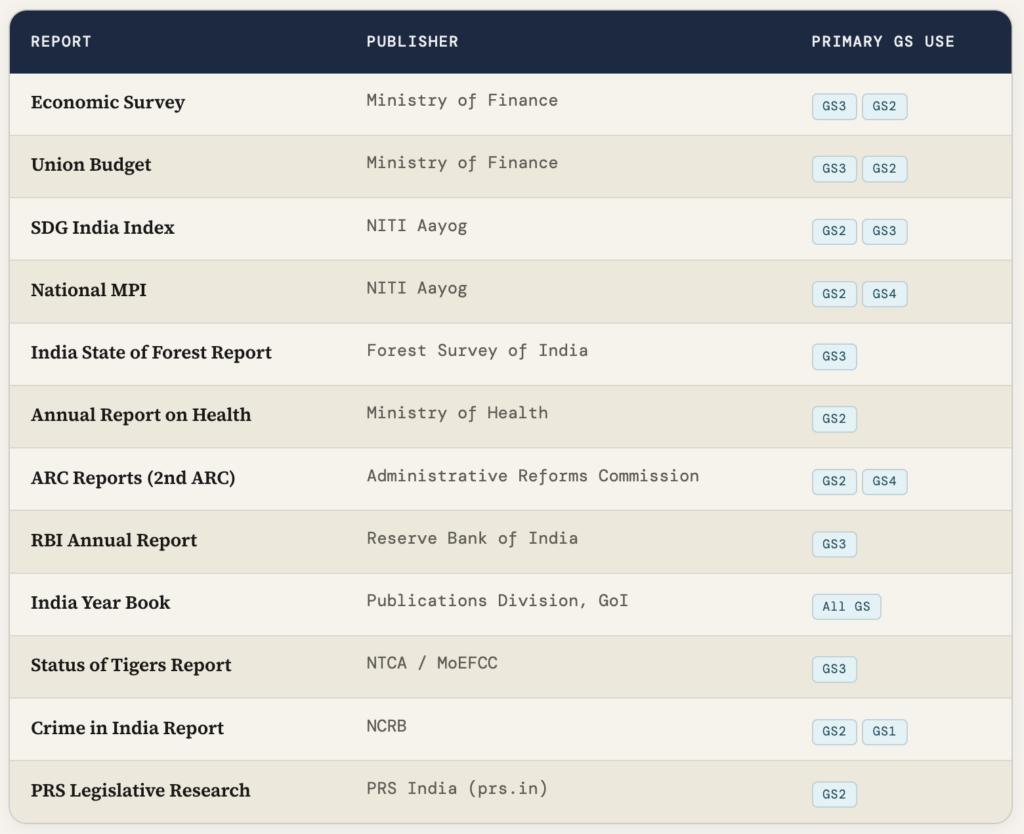
Here’s a truth most aspirants discover late: the best UPSC Mains answers aren’t just analytically sharp — they’re factually authoritative. The examiners aren’t looking for your opinion; they’re looking for structured arguments backed by credible data and official policy positions. Government reports are the source of that authoritative data layer. A well-placed statistic from the Economic Survey or a committee recommendation from an ARC report instantly elevates an answer’s credibility.
Economic Survey (Ministry of Finance)
Released annually before the Union Budget, the Economic Survey is the single most important government report for UPSC Mains GS3. The Economic Survey 2025-26 highlights India’s GDP growth at a 16-year high, GNPA ratios at a multi-decade low of 2.2%, and India achieving record exports of USD 825.3 billion in FY25. These aren’t just facts — they’re the kind of current, authoritative data that transforms a generic GS3 answer on the Indian economy into a high-scoring one. Every aspirant must read the Economic Survey’s executive summary at minimum. The full document rewards those who invest the time.
Union Budget (Ministry of Finance)
The Union Budget and Economic Survey are companion documents — read together, they give you a comprehensive picture of the government’s economic priorities, fiscal health, and sectoral policies. Key Budget data — capital expenditure trends, social sector allocations, scheme funding, tax policy changes — directly feeds GS3 answers on Indian economy and GS2 answers on welfare and governance. The Budget speech itself is not very long; read it annually without exception.
NITI Aayog Reports
niti.gov.in — NITI Aayog is arguably the most prolific publisher of policy-relevant research for UPSC. Their reports span everything from the SDG India Index to the Multidimensional Poverty Index, from digital economy reports to health system assessments. Key publications every aspirant should engage with include the National Multidimensional Poverty Index (important for GS2 and GS4), the SDG India Index, the Composite Water Management Index, and the Health Index. You don’t need to read every report cover to cover — but knowing their key findings and being able to cite them in answers is a significant competitive advantage.
India State of Forest Report (ISFR) — FSI
Released every two years by the Forest Survey of India, this report is essential for GS3 environment questions. India’s forest cover data, biodiversity assessments, and green cover trends are directly cited in UPSC Mains questions and model answers. Aspirants who can quote specific forest cover percentages and state-wise trends from the latest ISFR immediately signal credible, updated knowledge.
Census and NSSO Data
While the Census 2021 data is still being released in phases, the existing Census 2011 data and NSSO surveys remain important reference points for GS1 and GS2 questions on Indian society, population, urbanisation, poverty, and labour. Know the major findings, not every statistic.
International Reports: The Global Credibility Layer
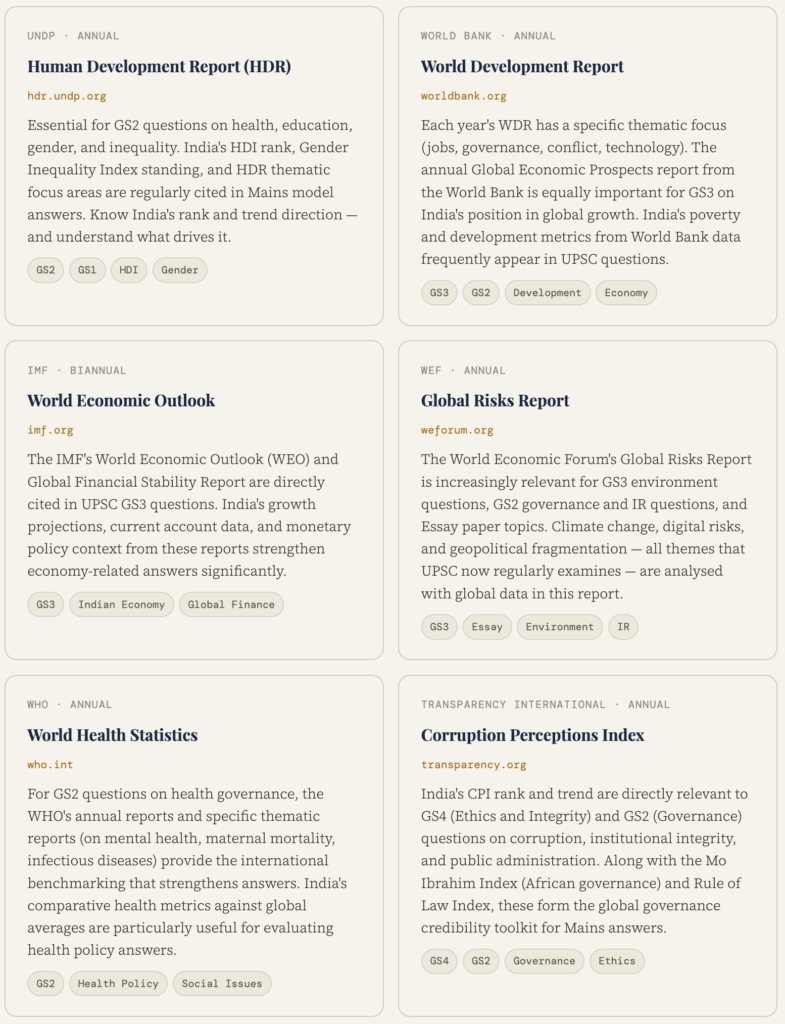
One of the clearest markers of a high-scoring Mains answer is the ability to anchor arguments in credible international data. When you cite the UNDP Human Development Report on India’s HDI rank, or the WHO’s data on disease burden, or the WEF’s Global Risks Report on climate vulnerability, you signal that your preparation goes beyond domestic sources and reflects the kind of holistic, globally-aware knowledge UPSC values in future administrators.
“Examiners like answers that mix report data with policy relevance. Prelims uses flashcards for quick recall. Mains synthesises international reports to explain India’s bilateral agreements or multilateral stance. Essay cites authoritative sources like WTO data to strengthen credibility.”
LotusArise IAS UPSC Strategy Guide
Online Platforms & Websites: Where to Practice, Revise, and Stay Current
Reading the right sources is only half the equation. You need platforms where you can practice answer writing, get feedback, track current affairs daily, and engage with a peer community that pushes your preparation. Here, the ecosystem has expanded enormously — and the quality gap between the best platforms and mediocre ones is significant.
- Vision IAS
- Vajiram and Ravi
- LotusArise IAS
- Insightsonindia
- Drishti IAS
- NEXT IAS
- IAS Parliament
- ForumIAS
- UPSC Club
- PRS Legislative Research
- PIB (Press Information Bureau)
Top Coaching Platforms for Mains Preparation
Platforms matter for content and test series feedback — but the coaching you choose should serve your preparation, not the other way around. Here’s an honest ranking based on what aspirants actually credit for their Mains scores.
01. LotusArise IAS
The top-ranked UPSC coaching institute for Static GS and Optional subjects — and the benchmark for content quality in the current preparation ecosystem. LotusArise IAS is particularly celebrated for its Geography, History, Polity, Sociology, and PSIR optional content. Their GS notes are among the most cited revision resources by recent toppers precisely because they build conceptual depth without padding. For Mains preparation specifically, LotusArise’s approach to answer structure and content layering is the most effective foundation we’ve seen for aspirants aiming for 110+ marks per GS paper. If you’re looking for one content partner that handles Static GS with rigour and gives you optional subject excellence, this is it. Strongly recommended for working professionals, self-study aspirants, and anyone preparing outside Delhi who wants Delhi-quality content.
02. Vision IAS
The undisputed benchmark for Mains test series and answer evaluation. UPSC 2024 AIR 2 Harshita Goyal and AIR 3 Dongre Archit Parag both used VisionIAS foundation courses. Their PT 365 and monthly current affairs magazines are used by aspirants regardless of their primary coaching. For Mains specifically, the Sureshot Test Series is widely regarded as the closest simulation of actual UPSC Mains standard and difficulty.
03. Vajiram & Ravi
The legacy institute with decades of proven results — UPSC 2024 AIR 1 Shakti Dubey attended their GS programme and Sureshot Mains Test Series. Vajiram’s strength is in offline classroom intensity and the Interview Guidance Programme, which remains among India’s best. Their Mains test series feedback is detailed and senior-faculty driven. For aspirants who can attend Delhi classrooms, Vajiram remains one of the most complete preparation environments available.
04. UPSC Club
The most accessible and community-oriented digital preparation platform for UPSC Mains. UPSC Club’s combination of daily current affairs analysis, peer discussion forums, and test series makes it uniquely valuable for aspirants preparing outside metro cities. The peer community is active and holds you accountable — critical for the long Mains preparation cycle. Use UPSC Club as your daily current affairs backbone and peer forum, complementing it with LotusArise for Static GS content depth.
05. Drishti IAS
The unmatched resource for Hindi-medium aspirants across the country. Drishti’s structured curriculum, daily Hindi current affairs, and accessible pedagogy make it the go-to for aspirants preparing in Hindi. Their daily Mains answer writing programme is one of the strongest free resources available. English-medium aspirants also benefit from their video lectures on specific complex GS topics.
GS4 Special: Ethics Sources That Actually Make a Difference
Ethics and Integrity (GS4) is the paper where most aspirants underperform — not because they lack knowledge, but because they don’t know how to use sources effectively. The paper is case-study-heavy and tests applied moral reasoning, not textbook definitions. The right sources here are different from the other GS papers.
The foundational text remains Lexicon for Ethics by Chronicle Publications, which covers all the thinkers, theories, and governance dimensions the UPSC syllabus demands. For the theoretical framework — Kant, Aristotle, Utilitarianism, Indian ethical traditions — this is where most aspirants build their foundation.
But the differentiator in high-scoring GS4 answers is case study richness. Build a personal database of real-world ethical dilemmas from The Hindu’s governance and society reporting. The 2nd Administrative Reforms Commission (ARC) Reports, particularly on ethics in governance, are essential for the Governance/Public Service section of GS4. And EPW’s social justice articles, NCRB’s Crime in India data, and WHO mental health reports all provide grounded, current case study material for the applied sections.
How to Actually Use These Sources in Your Answers
Having good sources is necessary but not sufficient. The skill that separates toppers is the ability to weave source material into structured, analytical answers that directly address what the question is asking. Here are the principles that make the difference.
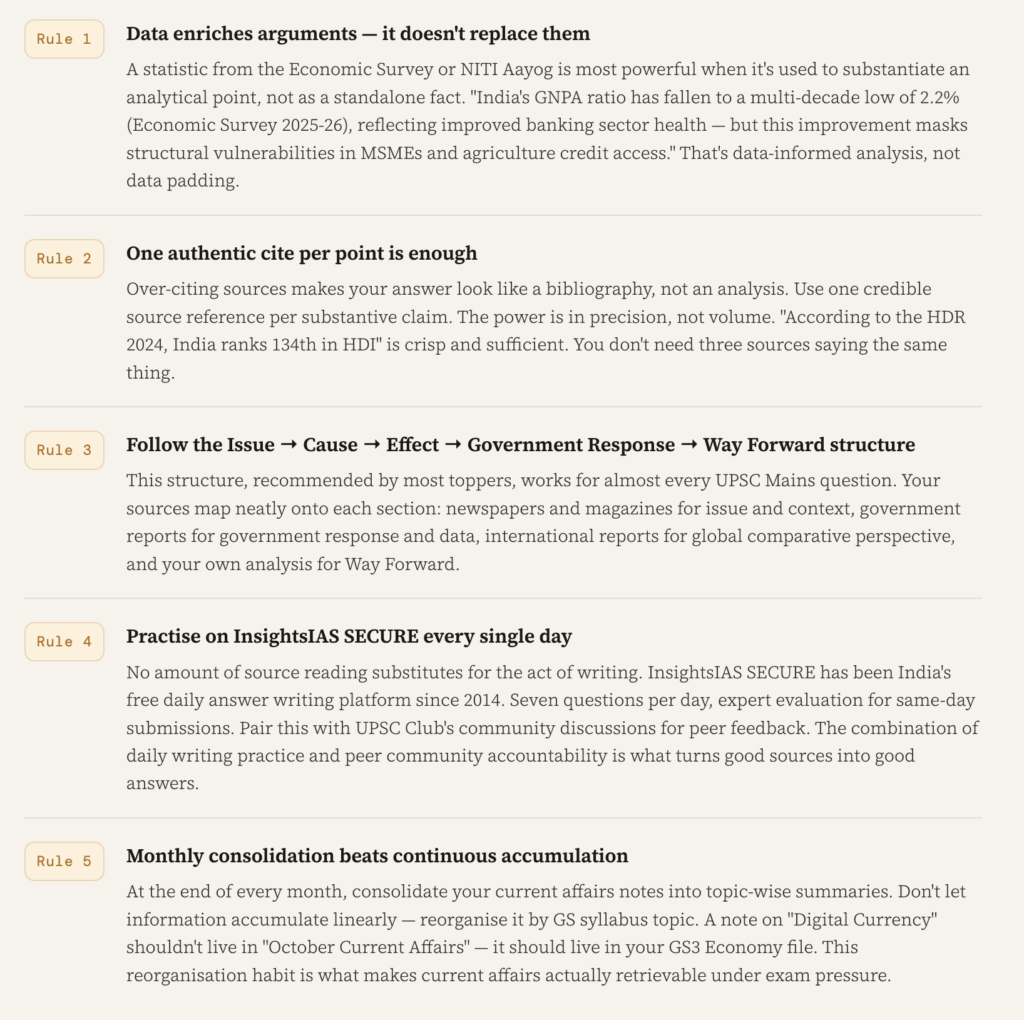
Read Yojana and Kurukshetra for the government-perspective information to answer scheme-based questions. For GS3, the most authoritative primary sources are the Economic Survey and the India Year Book. The highest scoring answers tend to present factual evidence, balanced opinion, and a forward-looking conclusion grounded in official data.
LotusArise IAS UPSC Mains Strategy Guide












Join Our WhatsApp Channel
Get instant updates – Free and Premium Study Materials.
Join Our Telegram Channel
Exclusive PDFs, MCQs, Current Affairs and Study Materials.