
For UPSC Geography Optional, start with NCERTs for basics, then move to standard references recommended by toppers and coaching institutes. These books cover the syllabus for both Paper 1 (Physical & Human Geography) and Paper 2 (India Geography) effectively. Focus on selective reading and note-making.
🧭 Step 1: Build Foundation (Non-Negotiable)
The foundation stage for UPSC Geography Optional builds conceptual clarity on basics before advancing to advanced texts. It typically spans 2-3 months for beginners, focusing on NCERTs and atlases to grasp fundamentals without overwhelming details. This stage ensures you understand core principles in physical, human, and Indian geography.
✔️ Core Foundation Books
Start exclusively with these to avoid confusion from multiple sources.
- NCERT Class 6-10 Geography: Covers basics like earth structure, resources, and agriculture. Read all chapters selectively for simple language and diagrams.
- NCERT Class 11-12 Geography:
- Class 11: Fundamentals of Physical Geography (landforms, climate, oceans); India – Physical Environment.
- Class 12: Fundamentals of Human Geography (population, settlements); India – People and Economy.
- Certificate Physical and Human Geography by G.C. Leong: Excellent for visual explanations of climate, landforms, and biomes; read after NCERTs.
- Oxford School Atlas: Practice 10-15 maps daily for location skills, essential for Paper 2.
🎯 Why these matter:
- NCERT = Concept clarity + diagrams
- GC Leong = Physical geography backbone
- Made Simple = Simplified coverage of topics
👉 These alone cover a large chunk of conceptual understanding.
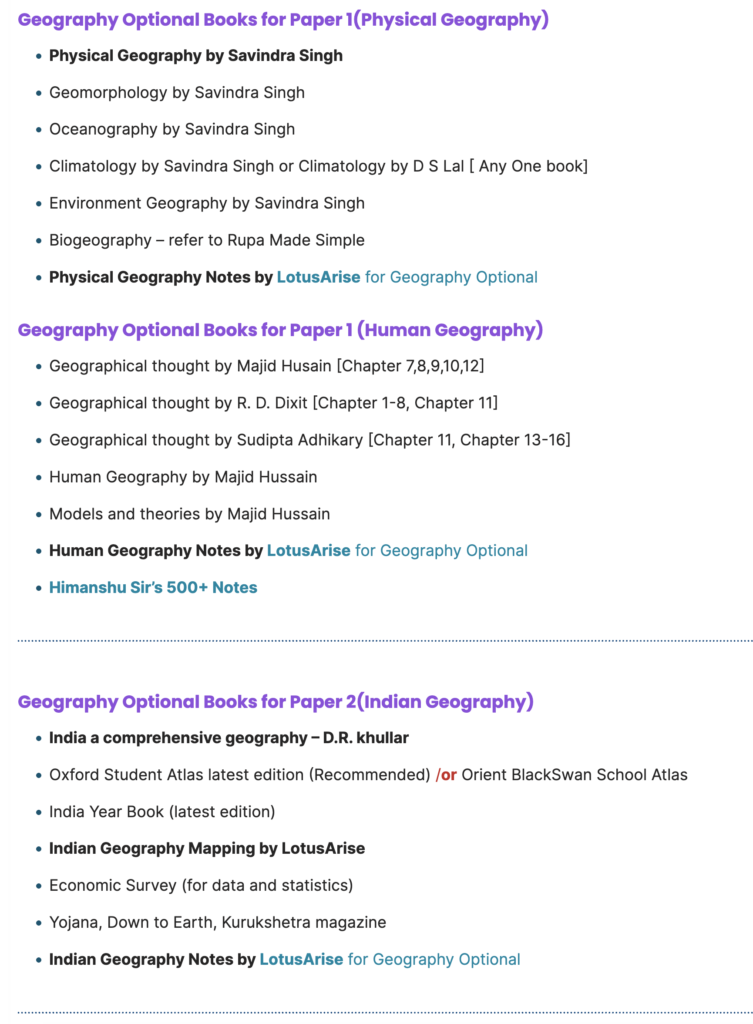
🌍 Step 2: Geography Optional – Paper 1 (Core Books)
Geography Optional Paper 1 covers physical geography (geomorphology, climatology, oceanography, biogeography), human geography (perspectives, models, population), and environmental geography. Core books provide in-depth coverage beyond NCERTs, emphasising diagrams, theories, and processes. Toppers recommend 5-7 selective reads with note-making.
🌋 A. Physical Geography
- Savindra Singh – Physical Geography
- Selected topics from:
- Geomorphology – Savindra Singh
- Climatology – D.S. Lal / Savindra Singh
- Oceanography – Savindra Singh
- LotusArise IAS Notes PDF for Geography Optional
- 👉 These books provide depth + scientific explanation, essential for scoring.
👥 B. Human Geography
- Indian and World Geography by Majid Husain
- Human Geography – Majid Husain
- Models & Theories – Majid Husain
- Evolution of Geographical Thought:
- R.D. Dixit / Sudipta Adhikari
- LotusArise IAS Notes PDF for Geography Optional
- 👉 Human Geography is the most scoring part if you use thinkers + diagrams.
🇮🇳 Step 3: Geography Optional – Paper 2 (Indian Geography)
Geography Optional Paper 2 focuses on Indian geography, including physical features, resources, agriculture, industry, transport, population, settlements, and regional planning. Core books emphasise India-specific data, maps, and current linkages. Toppers prioritise 4-6 books with atlas practice for 140+ marks.
📚 Must-Read Books
- Geography of India by Majid Husain: Standard text for physical setting, resources, population, economy; UPSC questions often derived from it.
- India: A Comprehensive Geography by D.R. Khullar: Detailed on physiography, climate, agriculture, industries; good diagrams.
- Oxford School Atlas (latest edition): Must-have for map-based questions on resources, disasters, and planning.
- Mapping Book (PDF) by LotusArise IAS.
- Economic Survey + Current Affairs
- LotusArise IAS Notes PDF for Geography Optional
👉 Paper 2 is dynamic + analytical, so books alone are not enough.
🗺️ Step 4: Atlas (Game Changer)
- Oxford School Atlas (Highly Recommended)
- Mapping Book (PDF) by LotusArise IAS.
👉 Maps = free marks in Mains + Prelims advantage
📖 Step 5: Value Addition (High Rank Booster)
- Previous Year Questions (PYQs) – Download from the LotusArise IAS website
- Geography IAS Mains PYQ Solved Papers – Available on the LotusArise IAS website
- Geography Optional Topicwise Unsolved Papers – Download from the LotusArise IAS website
👉 PYQs tell you:
- What UPSC actually asks
- How deep to study
- Which topics matter most
🧠 Reality Check (Most Important Part)
- Let’s be honest. 👉 If you try to read every book cover to cover, you will fail.
- Instead:
- Read 1 primary source per topic
- Use others only for value addition
- Focus on:
- Diagrams
- Case studies
- Current examples
- 📌 Geography is not about information. It’s about presentation + interlinking.
⚡ Smart Book Strategy (Topper Approach)
- 🔹 Phase 1: Foundation
- NCERT + GC Leong
- 🔹 Phase 2: Core Coverage
- Savindra Singh + Majid Husain
- 🔹 Phase 3: Enrichment
- Notes + PYQs + Current Affairs
- 🔹 Phase 4: Revision
- 3–4 revisions minimum
🔥 Pro Tip (What Toppers Actually Do)
- Many toppers don’t rely only on books.
- They combine:
- Standard books
- Coaching notes (Prefer the LotusArise IAS website for High Quality Optional Notes)
- PYQs + answer writing
- 👉 Because Geography optional is less about reading more and more about writing better answers with diagrams and examples.



Join Our WhatsApp Channel
Get instant updates – Free and Premium Study Materials.
Join Our Telegram Channel
Exclusive PDFs, MCQs, Current Affairs and Study Materials.