
“Public Administration has made a fierce resurgence in UPSC Mains. But the era of scoring 300+ by reciting generic textbook definitions is dead. Evaluators heavily penalize answers that read like General Studies and reward candidates who seamlessly interweave administrative thinkers, 2nd ARC recommendations, and contemporary administrative reforms.”
UPSC CSE Public Administration Evaluation Trends
Selecting the best notes for Public Administration optional is the single most critical tactical decision for your civil services Mains preparation. Public Administration (Pub Ad) remains one of the most intellectually relevant optionals for future bureaucrats, boasting unparalleled synergy with General Studies Paper 2 (Governance and Constitution), General Studies Paper 4 (Ethics and Integrity), and the Essay paper.
However, many aspirants get trapped in a 230-to-250 score plateau because they rely on fragmented coaching photocopies, decades-old printed dictations, or bulky academic treatises. In this comprehensive, unbiased review, we evaluate and rank the leading Public Administration study materials available today—LotusArise IAS, Pavan Kumar IAS, Synergy IAS (M.K. Mohanty), Lukmaan IAS (S. Ansari), and Vajiram & Ravi—to help you select the ideal foundation for UPSC 2026–2027.
What Defines a 300+ Public Administration Note Today?
Before evaluating individual coaching materials, every aspirant must assess their study notes against the four non-negotiable criteria of modern UPSC evaluation:
- Cross-Paper Thinker Integration: Notes must teach you how to apply Paper 1 administrative thinkers (such as Herbert Simon’s bounded rationality, Chris Argyris’s maturity-immaturity model, or Fred Riggs’s prismatic sala model) directly into Paper 2 Indian administrative problems (like lateral entry, district collector workload, or regulatory commissions).
- Second Administrative Reforms Commission (2nd ARC) Integration: The 15 reports of the 2nd ARC form the de facto answer key for Paper 2. High-scoring notes embed verbatim ARC recommendations directly into syllabus chapters.
- Administrative Flowcharts & Organizational Schematics: Notes must provide clean, reproducible visual models (such as Weber’s bureaucratic hierarchy, Likert’s System 4, and Simon’s decision-making flow) that can be sketched in under 90 seconds.
- Integrated 35-Year Topic-Wise PYQs: Past questions must be embedded directly beneath each sub-topic to train your mind on the exact analytical framing demanded by UPSC.
Comparative Ranking of Public Administration Optional Notes
The matrix below provides an objective side-by-side assessment across content currency, thinker integration, ARC report depth, and self-study feasibility:
| Material / Institute | Content Depth & Currency | Thinker Cross-Linkages | 2nd ARC & Reforms Integration | Self-Study Friendliness | Overall Verdict |
|---|---|---|---|---|---|
| 1. LotusArise IAS Notes | Comprehensive (2026–2027 edition); 100% syllabus; beginner layer | Exhaustive (Pre-built Paper 1 to Paper 2 linkages) | Fully embedded (All 15 ARC reports & Punchhi Commission) | Yes (10/10) — Self-contained with 35-yr PYQs | Best Overall & Most Updated |
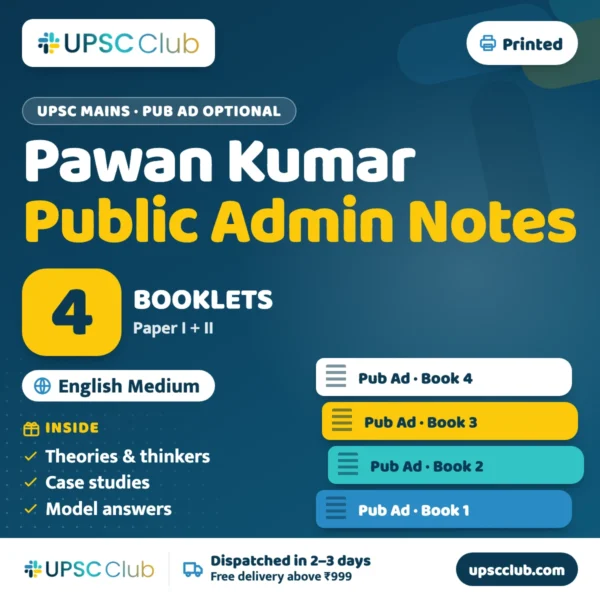
| 2. Pavan Kumar IAS | Solid conceptual depth; classroom dictation style | Strong in classical administrative theories | Moderate; requires supplementary ARC reading | Moderate (7/10) — Difficult without lectures | Great for classroom students; bulky for self-study |
| 3. Synergy IAS (M.K. Mohanty) | Strong analytical focus on Paper 1 thinkers | Good philosophical depth in Weber and Simon | Moderate in Paper 2 Indian administration | Moderate (7/10) — Academic, dense prose | Strong theoretical base; needs dynamic updates |
| 4. Lukmaan IAS (S. Ansari) | Case-study oriented; good governance emphasis | Moderate; focuses heavily on administrative ethics | Strong focus on 4th ARC report (Ethics in Governance) | Good (7.5/10) — Structured question formats | Excellent for ethical and governance dimensions |
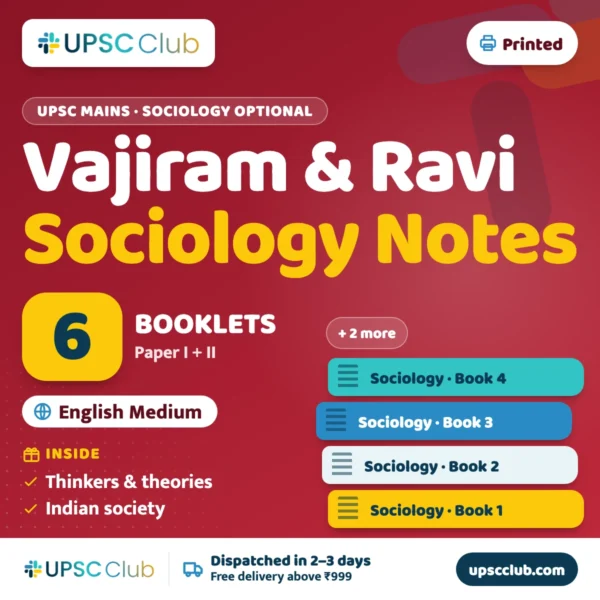
| 5. Vajiram & Ravi | Traditional postal material; extensive factual coverage | Standard textbook-style summaries | Standard coverage of commissions and committees | Moderate (6.5/10) — Requires personal condensing | Comprehensive legacy notes; feels bulky |
1. LotusArise IAS Public Administration Notes — Rank #1 (The Gold Standard)
LotusArise IAS stands firmly at the top of our ranking as the most meticulously updated, comprehensive, and student-centric study resource available for Public Administration optional today.
Unlike coaching class photocopies that rely on student scribbles or static material written a decade ago, LotusArise Public Administration Master Notes have been authored from the ground up specifically to align with current UPSC Mains evaluation criteria. The entire syllabus is organized systematically into standalone, high-scoring modules covering both Paper 1 (Administrative Theory, Thinkers, Behavioralism, Public Policy, Financial Administration) and Paper 2 (Indian Administration, Evolution, Union Government, District Administration, and Contemporary Reforms).
Key Strengths of LotusArise Pub Ad Notes:
- Dual-Layer Beginner-Friendly Design: Every major unit opens with an intuitive “In Simple Words” callout box, breaking down complex theories (like Chester Barnard’s zone of indifference, Simon’s premises of decision-making, or Riggs’s diffracted society) into plain English before introducing scholars and debates.
- Seamless Thinker Cross-Linkages: Solves the biggest challenge in Pub Ad by systematically linking Paper 1 thinkers to Paper 2 Indian administration in every single chapter. For instance, district administrative coordination is framed using Gulick’s POSDCORB and Follett’s constructive conflict resolution.
- Exhaustive 2nd ARC Integration: Verbatim findings and actionable recommendations from all 15 reports of the Second Administrative Reforms Commission are embedded directly into the relevant chapters (Ethics in Governance, Refurbishing Personnel Administration, Local Governance, Crisis Management).
- High-Yield Diagrammatic Schematics: Every chapter includes print-ready organizational flowcharts, matrix models, and administrative decision trees that can be sketched in under 90 seconds.
- Integrated 35-Year Topic-Wise PYQs: Past questions from 1985 through 2025 are mapped verbatim right beneath each relevant topic, allowing immediate answer-writing practice.
You can explore the full curriculum and sample chapters on the official LotusArise Public Administration Store or review foundational guides on the LotusArise Platform.
2. Pavan Kumar IAS Notes — Rank #2 (The Classroom Favourite)
Pavan Kumar Sir is widely recognized as one of the most prominent classroom teachers for Public Administration in Delhi. His classroom lecture notes and printed test series model answers have a massive following.
Pros & Cons:
- Strengths: Strong conceptual breakdown of classical administrative theories and accountability mechanisms. Good structuring of philosophical debates in public policy and bureaucratic ethics.
- Limitations: As printed running notes, they are voluminous and heavily reliant on attending live lectures. For self-study candidates studying in isolation, deciphering classroom shorthand and synthesizing disparate handouts into concise revision notes takes substantial time.
3. Synergy IAS (M.K. Mohanty) Notes — Rank #3 (The Theoretical Stalwart)
M.K. Mohanty Sir at Synergy IAS has guided civil services aspirants for decades, particularly emphasizing foundational clarity in Paper 1 administrative thought.
Pros & Cons:
- Strengths: Excellent intellectual rigor when exploring Max Weber’s ideal-type bureaucracy, Karl Marx’s critique of state administration, and Herbert Simon’s logical positivism.
- Limitations: The style is academic and dense. Paper 2 sections lack contemporary dynamic updates regarding lateral entry reforms, digital public infrastructure (DPI), Mission Karmayogi, and recent regulatory governance debates.
Final Recommendation: Which Notes Should You Choose?
- If you want the most complete, updated, and ready-to-revise resource: Go with LotusArise IAS Master Notes. It provides 100% syllabus coverage, beginner explanations, pre-built thinker linkages, print-ready diagrams, and 35-year PYQs in an integrated, self-study master system.
- If you already have Pavan Kumar or Synergy notes: You can retain them for core classical definitions, but you must aggressively supplement them with contemporary 2nd ARC recommendations, modern administrative case studies, and post-2020 PYQ answer structuring.
For more detailed strategy guides, explore our dedicated UPSC Optional strategy section and check official exam notifications on the UPSC Civil Services Examination portal.
Join Our WhatsApp Channel
Get instant updates – Free and Premium Study Materials.
Join Our Telegram Channel
Exclusive PDFs, MCQs, Current Affairs and Study Materials.