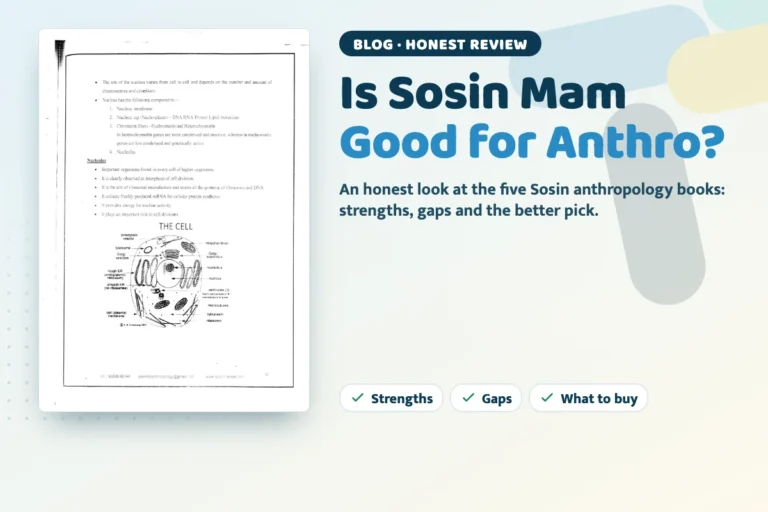
“In an optional landscape crowded with decades-old coaching photocopies and superficial paperbacks, LotusArise has reimagined what comprehensive UPSC study material should look like: beginner-friendly, mathematically accurate in genetics, diagram-ready, and anchored in 35 years of PYQs.”
UPSC CSE Optional Study Material Assessment
Over the past two years, LotusArise IAS Anthropology Master Notes has become one of the most widely discussed and recommended study resources across UPSC discussion communities on Reddit, Quora, and Telegram. Aspirants frequently praise its clarity, modern formatting, and comprehensive syllabus coverage.
However, before investing in any study material, serious civil services aspirants demand an honest, objective assessment: Is LotusArise IAS Anthropology material really worth it? Does it live up to its reputation as the best resource for securing 300+ marks? Can you rely on it as a 100% standalone single source without purchasing traditional textbooks?
In this in-depth, transparent review, we dissect the architecture of LotusArise Anthropology Notes, examine its unique features, evaluate its coverage against actual UPSC Mains papers, and deliver an impartial verdict.
What is LotusArise IAS Anthropology Master Notes?
LotusArise Anthropology Notes is a dedicated digital master curriculum covering 100% of the UPSC CSE Anthropology optional syllabus. It spans 54 comprehensive modules in Paper 1 and 36 modules in Paper 2, totaling over 1,100 pages of synthesized, high-scoring material.
Unlike coaching class notes—which are transcribed from spoken lectures—LotusArise was authored specifically as a modern textbook alternative. It synthesizes the most authoritative academic texts in the discipline: P. Nath, B.M. Das, Shukla & Rastogi (Physical); Ember & Ember, Upadhyay & Pandey, Makhan Jha (Socio-Cultural); D.K. Bhattacharya (Prehistory); and Nadeem Hasnain, L.P. Vidyarthi, Virginius Xaxa (Indian Anthropology).
The 5 Defining Strengths of LotusArise Notes
1. The “In Simple Words” Beginner Layer
Every major section opens with a 2- to 3-sentence plain English summary in an intuitive callout box. It tells the reader what the concept is and why it matters before any dense academic theory or scholar names are introduced. Non-science aspirants can read complex genetics and evolutionary biology chapters without frustration.
2. Flawless Physical Anthropology & Genetics
Units 1.4 to 1.7 and Units 9 to 12 are treated with complete scientific accuracy. Mendelian inheritance, Hardy-Weinberg equilibrium calculations, chromosomal syndromes, and molecular genetic markers (ABO, Rh, HLA, transferrins) are presented with clear clinical details and worked mathematical examples.
3. High-Yield Print-Ready Diagram Vault
Every single unit includes 4 to 6 clean, professional diagrams (cranial profiles, bipedal pelvis flaring, dentition patterns, Acheulian stone tools, and pedigree charts). These illustrations are formatted specifically to be memorized and reproduced in exams under 90 seconds.
4. Immunity Against the Paper 2 “GS Trap”
Paper 2 modules are anchored in authentic ethnographic field studies (Dongria Kondh in Niyamgiri, Jenu Kurubas in Nagarhole, Birhor sedentarization, Chenchu nutrition) and official committee reports (Virginius Xaxa Committee 2014, Bhuria Committee for PESA). Answers written from LotusArise never read like generic General Studies essays.
5. Embedded 35-Year PYQs (1985–2025)
All past UPSC questions asked on each topic over the last 35 years are listed verbatim directly beneath each sub-unit, allowing immediate answer-writing practice.
Pros & Cons at a Glance
| Pros (What Makes It Stand Out) | Cons (Considerations for Aspirants) |
|---|---|
| 100% complete syllabus coverage with zero blind spots | Substantial reading volume (~1,100 pages total) |
| Intuitive beginner explanations with glossed technical terms | Requires disciplined self-study commitment |
| 4–6 print-ready diagrams in every chapter | Digital/PDF format (aspirants who prefer physical books must print) |
| Embedded 35-year topic-wise PYQs (1985–2025) | High content depth requires 2–3 revision cycles |
| Contemporary Paper 2 case studies & Xaxa recommendations | Not a quick 100-page summary booklet |
Final Verdict: Is LotusArise Worth It?
Verdict: 9.8 / 10 — Highly Recommended.
If you are an aspirant looking for a single, authoritative, and truly self-contained study system that eliminates the need to buy 8 different textbooks or spend ₹60,000 on coaching institutes, LotusArise IAS Anthropology Master Notes is hands-down the best investment you can make for your UPSC Mains preparation.
To inspect curriculum previews and download sample chapters, visit the official LotusArise Anthropology Store or explore comprehensive subject guides on the LotusArise Platform.

Join Our WhatsApp Channel
Get instant updates – Free and Premium Study Materials.
Join Our Telegram Channel
Exclusive PDFs, MCQs, Current Affairs and Study Materials.